


Page 138 - Encyclopedia of Aquarium and Pond Fish, 3rd Edition
P. 138
136    FRESHWATER FISH DIRECTORY

         CICHLIDS


         This large group of fish (the name of which is
         pronounced “sick-lids”) originates mainly from
         Central and South America and Africa, although three
         species (including one recent rediscovery) are known
         to come from Asia. The characteristics and
         requirements of cichlids are as diverse as
         their origins, and most make excellent
         pets. Some individuals may learn to
         recognize their owner and even become
         tame enough to take food from the hand.
         The breeding behavior of many cichlids
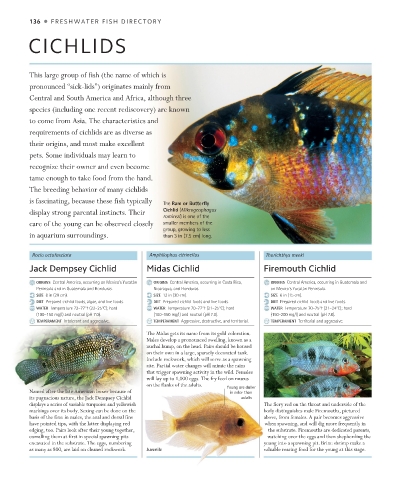
         is fascinating, because these fish typically   The Ram or Butterfly
         display strong parental instincts. Their    Cichlid (Mikrogeophagus
                                              ramirezi) is one of the
         care of the young can be observed closely   smaller members of the
                                              group, growing to less
         in aquarium surroundings.            than 3 in (7.5 cm) long.

          Rocio octofasciata              Amphilophus citrinellus         Thorichthys meeki
         Jack Dempsey Cichlid            Midas Cichlid                    Firemouth Cichlid

           ORIGINS  Central America, occurring on Mexico’s Yucatán   ORIGINS  Central America, occurring in Costa Rica,   ORIGINS  Central America, occurring in Guatemala and
           Peninsula and in Guatemala and Honduras.  Nicaragua, and Honduras.  on Mexico’s Yucatán Peninsula.
           SIZE  8 in (20 cm).             SIZE  12 in (30 cm).             SIZE  6 in (15 cm).
           DIET  Prepared cichlid foods, algae, and live foods.   DIET  Prepared cichlid foods and live foods.  DIET  Prepared cichlid foods and live foods.
           WATER  Temperature 72–77°F (22–25°C); hard    WATER  Temperature 70–77°F (21–25°C); hard    WATER  Temperature 70–75°F (21–24°C); hard
           (100–150 mg/l) and neutral (pH 7.0).   (100–150 mg/l) and neutral (pH 7.0).   (150–200 mg/l) and neutral (pH 7.0).
           TEMPERAMENT  Intolerant and aggressive.  TEMPERAMENT  Aggressive, destructive, and territorial.  TEMPERAMENT  Territorial and aggressive.
                                         The Midas gets its name from its gold coloration.
                                         Males develop a pronounced swelling, known as a
                                         nuchal hump, on the head. Pairs should be housed
                                         on their own in a large, sparsely decorated tank.
                                         Include rockwork, which will serve as a spawning
                                         site. Partial water changes will mimic the rains
                                         that trigger spawning activity in the wild. Females
                                         will lay up to 1,000 eggs. The fry feed on mucus
                                         on the flanks of the adults.  Young are duller
         Named after the late American boxer because of         in color than
         its pugnacious nature, the Jack Dempsey Cichlid            adults
         displays a series of variable turquoise and yellowish            The fiery red on the throat and underside of the
         markings over its body. Sexing can be done on the                body distinguishes male Firemouths, pictured
         basis of the fins: in males, the anal and dorsal fins            above, from females. A pair becomes aggressive
         have pointed tips, with the latter displaying red                when spawning, and will dig more frequently in
         edging, too. Pairs look after their young together,               the substrate. Firemouths are dedicated parents,
         corralling them at first in special spawning pits                 watching over the eggs and then shepherding the
         excavated in the substrate. The eggs, numbering                  young into a spawning pit. Brine shrimp make a
         as many as 800, are laid on cleaned rockwork.  Juvenile          valuable rearing food for the young at this stage.


   US_136-137_Cichlids.indd   136                                                                    29/08/18   4:09 PM

