


Page 128 - Encyclopedia of Aquarium and Pond Fish, 3rd Edition
P. 128
126    FRESHWATER FISH DIRECTORY


          Synodontis schoutedeni                                          Synodontis flavitaeniatus
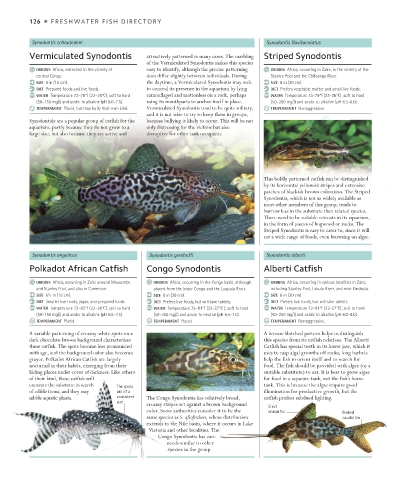
         Vermiculated Synodontis         attractively patterned in many cases. The marbling  Striped Synodontis
                                         of the Vermiculated Synodontis makes this species
           ORIGINS  Africa, restricted to the vicinity of    easy to identify, although the precise patterning   ORIGINS  Africa, occurring in Zaire, in the vicinity of the
           central Congo.                does differ slightly between individuals. During   Stanley Pool and the Chiloango River.
           SIZE  6 in (15 cm).           the daytime, a Vermiculated Synodontis may seek   SIZE  8 in (20 cm).
           DIET  Prepared foods and live foods.  to conceal its presence in the aquarium by lying   DIET  Prefers vegetable matter and small live foods.
           WATER  Temperature 72–79°F (22–26°C); soft to hard   camouflaged and motionless on a rock, perhaps   WATER  Temperature 73–79°F (23–26°C); soft to hard
           (50–150 mg/l) and acidic to alkaline (pH 6.0–7.5).  using its mouthparts to anchor itself in place.   (50–200 mg/l) and acidic to alkaline (pH 6.5–8.0).
           TEMPERAMENT  Placid, but may bully their own kind.  Vermiculated Synodontis tend to be quite solitary,   TEMPERAMENT  Nonaggressive.
                                         and it is not wise to try to keep them in groups,
         Synodontids are a popular group of catfish for the   because bullying is likely to occur. This will be not
         aquarium, partly because they do not grow to a   only distressing for the victims but also
         large size, but also because they are active and   disruptive for other tank occupants.


                                                                          This boldly patterned catfish can be distinguished
                                                                          by its horizontal yellowish stripes and extensive
                                                                          patches of blackish-brown coloration. The Striped
                                                                          Synodontis, which is not as widely available as
                                                                          most other members of this group, tends to
                                                                          burrow less in the substrate than related species.
                                                                          There need to be suitable retreats in its aquarium,
                                                                          in the form of pieces of bogwood or rocks. The
                                                                          Striped Synodontis is easy to cater to, since it will
                                                                          eat a wide range of foods, even browsing on algae.

          Synodontis angelicus            Synodontis greshoffi            Synodontis alberti
         Polkadot African Catfish        Congo Synodontis                 Alberti Catfish

           ORIGINS  Africa, occurring in Zaire around Mousembe   ORIGINS  Africa, occurring in the Congo basin, although   ORIGINS  Africa, occurring in various localities in Zaire,
           and Stanley Pool, and also in Cameroon.  absent from the lower Congo and the Luapula River.  including Stanley Pool, Lukulu River, and near Kinshasa.
           SIZE  6 ⁄2 in (18 cm).          SIZE  8 in (20 cm).              SIZE  8 in (20 cm).
              1
           DIET  Smaller live foods, algae, and prepared foods.  DIET  Prefers live foods, but will take tablets.  DIET  Prefers live foods, but will take tablets.
           WATER  Temperature 72–82°F (22–28°C); soft to hard   WATER  Temperature 73–81°F (23–27°C ); soft to hard   WATER  Temperature 72–81°F (22–27°C); soft to hard
           (50–150 mg/l) and acidic to alkaline (pH 6.5–7.5).   (50–200 mg/l) and acidic to neutral (pH 6.5–7.0).  (50–200 mg/l) and acidic to alkaline (pH 6.0–8.0).
           TEMPERAMENT  Placid.            TEMPERAMENT  Placid.             TEMPERAMENT  Nonaggressive.
         A variable patterning of creamy-white spots on a                 A brown-blotched pattern helps to distinguish
         dark chocolate-brown background characterizes                    this species from its catfish relatives. The Alberti
         these catfish. The spots become less pronounced                  Catfish has special teeth in its lower jaw, which it
         with age, and the background color also becomes                  uses to rasp algal growths off rocks; long barbels
         grayer. Polkadot African Catfish are largely                     help the fish to orient itself and to search for
         nocturnal in their habits, emerging from their                   food. The fish should be provided with algae (or a
         hiding places under cover of darkness. Like others               suitable substitute) to eat. It is best to grow algae
         of their kind, these catfish will                                for food in a separate tank, not the fish’s home
         excavate the substrate in search   The spots                     tank. This is because the algae require good
         of edible items, and they may   are of a                         illumination for productive growth, but the
         nibble aquatic plants.  consistent   The Congo Synodontis has relatively broad,   catfish prefers subdued lighting.
                                 size    creamy stripes set against a brown background   Erect
                                         color. Some authorities consider it to be the    dorsal fin  Forked
                                         same species as S. afrofischeri, whose distribution   caudal fin
                                         extends to the Nile basin, where it occurs in Lake
                                          Victoria and other localities. The
                                             Congo Synodontis has care
                                               needs similar to other
                                               species in the group.


   US_126-127_Synodontis.indd   126                                                                  29/08/18   4:09 PM

