


Page 135 - Encyclopedia of Aquarium and Pond Fish, 3rd Edition
P. 135
CATFISH/PIMELODIDS    133


          Pimelodus pictus                                                Brachyrhamdia meesi
         Pictus Catfish                  The Pictus Catfish is attractively patterned,    Pin Catfish
                                         with prominent black spots set against a silvery
           ORIGINS  Northern South America, especially in the   background. Its docile nature makes it suitable    ORIGINS  South America, in the Amazon region; its
           vicinity of Mitu, Colombia.   to be kept in a shoal, or mixed with other   precise distribution is presently unclear.
           SIZE  6 in (15 cm).           nonaggressive fish requiring similar water   SIZE  3 ⁄4 in (8 cm).
                                                                               1
           DIET  Prepared foods and live foods.   conditions. Feeding, too, presents no difficulties.   DIET  Live foods favored.
           WATER  Temperature 72–77°F (22–25°C); soft  to hard   Although these catfish are nocturnal, they may eat   WATER  Temperature 73–81°F (23–27°C); soft to hard
           (50–100 mg/l) and neutral (pH 7.0).  during the day under subdued lighting. Beware:   (50–200 mg/l) and neutral (pH 7.0).
           TEMPERAMENT  Placid.          their sharp pectoral fins may get stuck in netting.  TEMPERAMENT  Placid with unrelated fish of similar size.


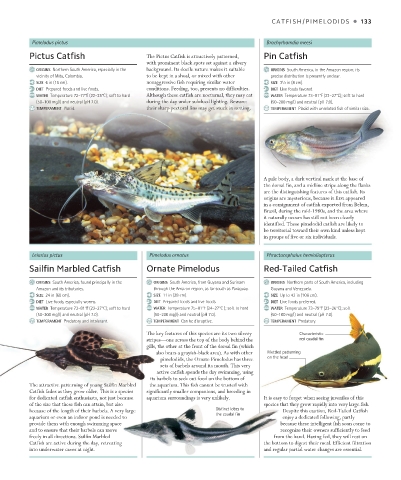
                                                                          A pale body, a dark vertical mark at the base of
                                                                          the dorsal fin, and a midline stripe along the flanks
                                                                          are the distinguishing features of this catfish. Its
                                                                          origins are mysterious, because it first appeared
                                                                          in a consignment of catfish exported from Belem,
                                                                          Brazil, during the mid-1980s, and the area where
                                                                          it naturally occurs has still not been clearly
                                                                          identified. These pimelodid catfish are likely to
                                                                          be territorial toward their own kind unless kept
                                                                          in groups of five or six individuals.

          Leiarius pictus                 Pimelodus ornatus               Phractocephalus hemioliopterus
         Sailfin Marbled Catfish         Ornate Pimelodus                 Red-Tailed Catfish

           ORIGINS  South America, found principally in the   ORIGINS  South America, from Guyana and Surinam   ORIGINS  Northern parts of South America, including
           Amazon and its tributaries.     through the Amazon region, as far south as Paraguay.  Guyana and Venezuela.
           SIZE  24 in (60 cm).            SIZE  11 in (28 cm).             SIZE  Up to 42 in (106 cm).
           DIET  Live foods, especially worms.  DIET  Prepared foods and live foods.  DIET  Live foods preferred.
           WATER  Temperature 73–81°F (23–27°C); soft to hard   WATER  Temperature 75–81°F (24–27°C ); soft to hard   WATER  Temperature 73–79°F (23–26°C); soft
           (50–200 mg/l) and neutral (pH 7.0).  (50–200 mg/l) and neutral (pH 7.0).  (50–100 mg/l) and neutral (pH 7.0).
           TEMPERAMENT  Predatory and intolerant.  TEMPERAMENT  Can be disruptive.  TEMPERAMENT  Predatory.
                                         The key features of this species are its two silvery   Characteristic
                                         stripes—one across the top of the body behind the   red caudal fin
                                         gills, the other at the front of the dorsal fin (which
                                            also bears a grayish-black area). As with other   Mottled patterning
                                             pimelodids, the Ornate Pimelodus has three   on the head
                                             sets of barbels around its mouth. This very
                                            active catfish spends the day swimming, using
                                          its barbels to seek out food on the bottom of
         The attractive patterning of young Sailfin Marbled   the aquarium. This fish cannot be trusted with
         Catfish fades as they grow older. This is a species   significantly smaller companions, and breeding in
         for dedicated catfish enthusiasts, not just because   aquarium surroundings is very unlikely.  It is easy to forget when seeing juveniles of this
         of the size that these fish can attain, but also                 species that they grow rapidly into very large fish.
         because of the length of their barbels. A very large   Distinct lobes to   Despite this caution, Red-Tailed Catfish
         aquarium or even an indoor pond is needed to        the caudal fin    enjoy a dedicated following, partly
         provide them with enough swimming space                              because these intelligent fish soon come to
         and to ensure that their barbels can move                            recognize their owners sufficiently to feed
         freely in all directions. Sailfin Marbled                           from the hand. Having fed, they will rest on
         Catfish are active during the day, retreating                    the bottom to digest their meal. Efficient filtration
         into underwater caves at night.                                  and regular partial water changes are essential.


   US_132-133_Pimelodids.indd   133                                                                  29/08/18   4:09 PM

