


Page 134 - Encyclopedia of Aquarium and Pond Fish, 3rd Edition
P. 134
132    FRESHWATER FISH DIRECTORY


                                          Microglanis iheringi            Hemisorubim platyrhynchos
           DIFFERING LIFESTYLES
                                         Bumblebee Catfish                Spotted Catfish
           Many pimelodid catfish are solitary by
           nature. They are predatory and grow to a    ORIGINS  Northwest South America, where it is found in   ORIGINS  South America, from Venezuela southward as
           large size, demanding an extensive area in   parts of Colombia and Venezuela.   far as Paraguay.
           which to hunt. However, a number of smaller   SIZE  4 in (10 cm).  SIZE  15 in (40 cm).
           species, including the Pictus Catfish   DIET  Prepared foods and live foods.   DIET  Prefers live foods of various types.
           (Pimelodus pictus) shown here, will associate   WATER  Temperature 70–77°F (21–25°C); soft to hard   WATER  Temperature 72–77°F (22–25°C); soft to hard
           in groups and can be kept together more   (50–200 mg/l) and neutral (pH 7.0).  (50–250 mg/l) and neutral (pH 7.0).
           easily in the home aquarium. Like various   TEMPERAMENT  Will prey on smaller companions.  TEMPERAMENT  Will prey on smaller companions.
           other pimelodids, Pictus Catfish are largely
           nocturnal. A special light that mimics the                     The size of this catfish means that it requires
           qualities of moonlight must be placed over                     suitably spacious accommodation from the outset.
           the tank if the fascinating behavior of these                  The Spotted Catfish has a large, rather bill-like
           fish is to be observed.                                        mouth, with prominent barbels and an elongated
                                                                          body shape. Its blotched appearance includes a
                                                                          variable pattern of dark spots on its sides.
                                                                          Spotted Catfish naturally frequent cooler,
                                                                          deeper waters and will rest on a bed of pebbles
                                                                          or a similar raised area during the day, becoming
                                                                          active as darkness falls.
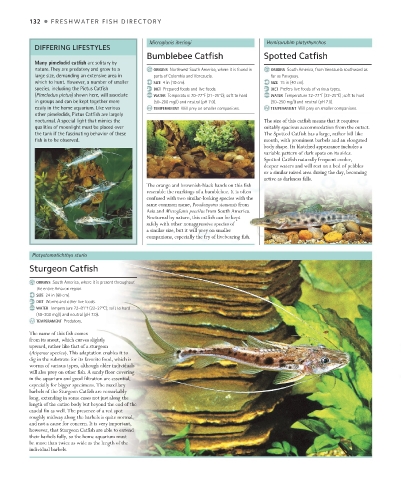
                                         The orange and brownish-black bands on this fish
                                         resemble the markings of a bumblebee. It is often
                                         confused with two similar-looking species with the
                                         same common name, Pseudomystus siamensis from
                                         Asia and Microglanis poecilus from South America.
                                         Nocturnal by nature, this catfish can be kept
                                         safely with other nonaggressive species of
                                         a similar size, but it will prey on smaller
                                         companions, especially the fry of livebearing fish.

          Platystomatichthys sturio
         Sturgeon Catfish

           ORIGINS  South America, where it is present throughout
           the entire Amazon region.
           SIZE  24 in (60 cm).
           DIET  Worms and other live foods.
           WATER  Temperature 72–81°F (22–27°C); soft to hard
           (50–200 mg/l) and neutral (pH 7.0).
           TEMPERAMENT  Predatory.
         The name of this fish comes
         from its snout, which curves slightly
         upward, rather like that of a sturgeon
         (Acipenser species). This adaptation enables it to
         dig in the substrate for its favorite food, which is
         worms of various types, although older individuals
         will also prey on other fish. A sandy floor covering
         in the aquarium and good filtration are essential,
         especially for bigger specimens. The maxillary
         barbels of the Sturgeon Catfish are remarkably
         long, extending in some cases not just along the
         length of the entire body but beyond the end of the
         caudal fin as well. The presence of a red spot
         roughly midway along the barbels is quite normal,
         and not a cause for concern. It is very important,
         however, that Sturgeon Catfish are able to extend
         their barbels fully, so the home aquarium must
         be more than twice as wide as the length of the
         individual barbels.


   US_132-133_Pimelodids.indd   132                                                                  29/08/18   4:09 PM

