


Page 139 - Encyclopedia of Aquarium and Pond Fish, 3rd Edition
P. 139
CICHLIDS    137


          Amphilophus labiatus            Cichlasoma severum
                                                                           CONFLICT RESOLUTION
         Red Devil                       Severum
                                                                           Although many cichlids are aggressive, most
           ORIGINS  Central America, restricted to Lake Xiloa, Lake   ORIGINS  Northern parts of South America, extending   disputes are resolved without actual physical
           Nicaragua, and Lake Managua in Nicaragua.  throughout the Amazon basin.  conflict. The bright red of the Firemouth
           SIZE  10 in (25 cm).            SIZE  8 in (20 cm).             Cichlid (Thorichthys meeki), shown below,
           DIET  Prepared cichlid foods and live foods.  DIET  Prepared cichlid foods and live foods.   warns other fish to steer clear. If this does
           WATER  Temperature 75–79°F (24–26°C); hard    WATER  Temperature 73–77°F (23–25°C); soft (50 mg/l)   not work as a deterrent, a Firemouth will
           (100–150 mg/l) and neutral (pH 7.0).   and acidic (pH 6.0–6.5).  inflate its throat and flare out its gill covers.
           TEMPERAMENT  Aggressive and territorial.  TEMPERAMENT  Territorial.  This makes the fish appear larger and more
                                                                           intimidating and may persuade a would-be
         Like a number of other Central American cichlid                   rival to back down and swim away. In the
         species, the Red Devil is relatively adaptable in   Juvenile      aquarium, however, conflict is more likely
         terms of its water chemistry needs. It is reddish,                because the fish cannot avoid one another.
         but the precise depth of coloration differs between
         individuals. The female of a pair, discernible by her
         blunt genital papilla and smaller size, may lay up
         to 700 eggs, guarding them until they hatch after
         about three days. It may take a further week for
         the fry to become free-swimming.

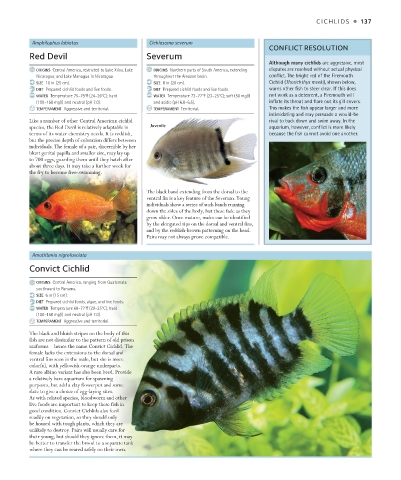
                                         The black band extending from the dorsal to the
                                         ventral fin is a key feature of the Severum. Young
                                         individuals show a series of such bands running
                                         down the sides of the body, but these fade as they
                                         grow older. Once mature, males can be identified
                                         by the elongated tips on the dorsal and ventral fins,
                                         and by the reddish-brown patterning on the head.
                                         Pairs may not always prove compatible.

          Amatitlania nigrofasciata
         Convict Cichlid

           ORIGINS  Central America, ranging from Guatemala
           southward to Panama.
           SIZE  6 in (15 cm).
           DIET  Prepared cichlid foods, algae, and live foods.
           WATER  Temperature 68–77°F (20–25°C); hard
           (100–150 mg/l) and neutral (pH 7.0).
           TEMPERAMENT  Aggressive and territorial.
         The black and bluish stripes on the body of this
         fish are not dissimilar to the pattern of old prison
         uniforms—hence the name Convict Cichlid. The
         female lacks the extensions to the dorsal and
         ventral fins seen in the male, but she is more
         colorful, with yellowish-orange underparts.
         A rare albino variant has also been bred. Provide
         a relatively bare aquarium for spawning
         purposes, but add a clay flowerpot and some
         slate to give a choice of egg-laying sites.
         As with related species, bloodworm and other
         live foods are important to keep these fish in
         good condition. Convict Cichlids also feed
         readily on vegetation, so they should only
         be housed with tough plants, which they are
         unlikely to destroy. Pairs will usually care for
         their young, but should they ignore them, it may
         be better to transfer the brood to a separate tank
         where they can be reared safely on their own.


   US_136-137_Cichlids.indd   137                                                                    29/08/18   4:09 PM

