


Page 140 - Encyclopedia of Aquarium and Pond Fish, 3rd Edition
P. 140
138    FRESHWATER FISH DIRECTORY


          Andinoacara pulcher             Cleithracara maronii            Andinoacara rivulatus
         Blue Acara                      Keyhole Cichlid                  Green Terror

           ORIGINS  Central and northern South America, from   ORIGINS  Northwestern South America, restricted to   ORIGINS  Northwestern South America, occurring in
           Panama to Colombia and Venezuela. Also in Trinidad.    parts of Guyana.  western Ecuador and central Peru.
           SIZE  8 in (20 cm).             SIZE  6 in (15 cm).              SIZE  8 in (20 cm).
           DIET  Prepared cichlid foods and live foods.   DIET  Prepared cichlid foods and live foods.   DIET  Prepared cichlid foods and live foods.
           WATER  Temperature 64–77°F (18–25°C); soft (50 mg/l)   WATER  Temperature 72–77°F (22–25°C); soft (50 mg/l)   WATER  Temperature 68–77°F (20–25°C); soft (50 mg/l)
           to neutral (pH 7.0).            and acidic (pH 6.5).             to neutral (pH 7.0).
           TEMPERAMENT  Territorial but not very aggressive.  TEMPERAMENT  Peaceful.  TEMPERAMENT  Territorial and aggressive.
         Although the exact coloration of Blue Acaras varies              Turquoise body markings separate these cichlids
         between individuals, they all display obvious bluish             from related species. The male, pictured below,
         markings set against a darker background. Mature                 is more brightly colored than the female and
         males can usually be identified by the extensions at             usually larger. Most males acquire a nuchal hump
         the rear of the dorsal and anal fins. Regular water              on the forehead as they mature. It is usually better
         changes to maintain water quality are very                       to keep pairs in a tank on their own, especially for
         important for Blue Acaras, while raising the water               breeding, offering plenty of retreats and spawning
         temperature slightly, up to 82°F (28°C), should                  surfaces. Hatching can take four days; the fry
         encourage spawning.                                              become free-swimming one week later.
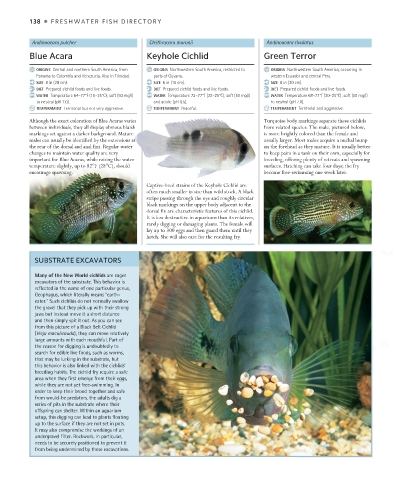
                                         Captive-bred strains of the Keyhole Cichlid are
                                         often much smaller in size than wild stock. A black
                                         stripe passing through the eye and roughly circular
                                         black markings on the upper body adjacent to the
                                         dorsal fin are characteristic features of this cichlid.
                                         It is less destructive in aquariums than its relatives,
                                         rarely digging or damaging plants. The female will
                                         lay up to 300 eggs and then guard them until they
                                         hatch. She will also care for the resulting fry.


           SUBSTRATE EXCAVATORS

           Many of the New World cichlids are eager
           excavators of the substrate. This behavior is
           reflected in the name of one particular genus,
           Geophagus, which literally means “earth-
           eater.” Such cichlids do not normally swallow
           the gravel that they pick up with their strong
           jaws but instead move it a short distance
           and then simply spit it out. As you can see
           from this picture of a Black Belt Cichlid
           (Vieja maculicauda), they can move relatively
           large amounts with each mouthful. Part of
           the reason for digging is undoubtedly to
           search for edible live foods, such as worms,
           that may be lurking in the substrate, but
           this behavior is also linked with the cichlids’
           breeding habits. The cichlid fry require a safe
           area when they first emerge from their eggs,
           while they are not yet free-swimming. In
           order to keep their brood together and safe
           from would-be predators, the adults dig a
           series of pits in the substrate where their
           offspring can shelter. Within an aquarium
           setup, this digging can lead to plants floating
           up to the surface if they are not set in pots.
           It may also compromise the workings of an
           undergravel filter. Rockwork, in particular,
           needs to be securely positioned to prevent it
           from being undermined by these excavations.


   US_138-139_Cichlids_2.indd   138                                                                  29/08/18   4:09 PM

