


Page 157 - Encyclopedia of Aquarium and Pond Fish, 3rd Edition
P. 157
CICHLIDS/LAKE TANGANYIKA CICHLIDS    155


                                                                          Neolamprologus brichardi
           WATCHFUL PARENTS
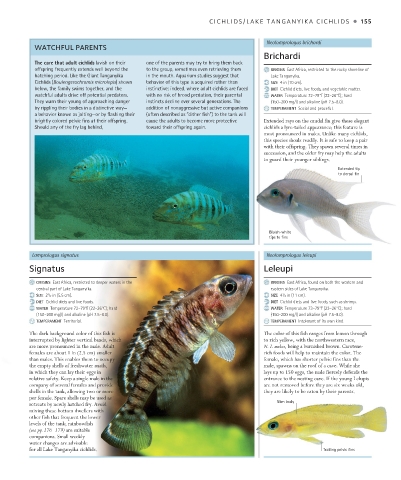
                                                                          Brichardi
           The care that adult cichlids lavish on their   one of the parents may try to bring them back
           offspring frequently extends well beyond the   to the group, sometimes even retrieving them    ORIGINS  East Africa, restricted to the rocky shoreline of
           hatching period. Like the Giant Tanganyika   in the mouth. Aquarium studies suggest that   Lake Tanganyika.
           Cichlids (Boulengerochromis microlepis) shown   behavior of this type is acquired rather than   SIZE  4 in (10 cm).
           below, the family swims together, and the   instinctive; indeed, where adult cichlids are faced   DIET  Cichlid diets, live foods, and vegetable matter.
           watchful adults drive off potential predators.    with no risk of brood predation, their parental   WATER  Temperature 72–79°F (22–26°C); hard
           They warn their young of approaching danger    instincts decline over several generations. The   (150–200 mg/l) and alkaline (pH 7.5–8.0).
           by rippling their bodies in a distinctive way—   addition of nonaggressive but active companions   TEMPERAMENT  Social and peaceful.
           a behavior known as jolting—or by flashing their   (often described as “dither fish”) to the tank will
           brightly colored pelvic fins at their offspring.   cause the adults to become more protective   Extended rays on the caudal fin give these elegant
           Should any of the fry lag behind,    toward their offspring again.  cichlids a lyre-tailed appearance; this feature is
                                                                          most pronounced in males. Unlike many cichlids,
                                                                          this species shoals readily. It is safe to keep a pair
                                                                          with their offspring. They spawn several times in
                                                                          succession, and the older fry may help the adults
                                                                          to guard their younger siblings.
                                                                                              Extended tip
                                                                                              to dorsal fin


                                                                           Bluish-white
                                                                           tips to fins
          Lamprologus signatus                                            Neolamprologus leleupi
         Signatus                                                         Leleupi

           ORIGINS  East Africa, restricted to deeper waters in the         ORIGINS  East Africa, found on both the western and
           central part of Lake Tanganyika.                                 eastern sides of Lake Tanganyika.
           SIZE  2 ⁄2 in (5.5 cm).                                          SIZE  4 ⁄4 in (11 cm).
              1
                                                                               1
           DIET  Cichlid diets and live foods.                              DIET  Cichlid diets and live foods, such as shrimp.
           WATER  Temperature 72–79°F (22–26°C); hard                       WATER  Temperature 73–79°F (23–26°C); hard
           (150–200 mg/l) and alkaline (pH 7.5–8.0).                        (150–200 mg/l) and alkaline (pH 7.5–8.0).
           TEMPERAMENT  Territorial.                                        TEMPERAMENT  Intolerant of its own kind.
         The dark background color of this fish is                        The color of this fish ranges from lemon through
         interrupted by lighter vertical bands, which                     to rich yellow, with the northwestern race,
         are more pronounced in the male. Adult                           N. l. melas, being a burnished brown. Carotene-
         females are about 1 in (2.5 cm) smaller                          rich foods will help to maintain the color. The
         than males. This enables them to occupy                          female, which has shorter pelvic fins than the
         the empty shells of freshwater snails,                           male, spawns on the roof of a cave. While she
         in which they can lay their eggs in                              lays up to 150 eggs, the male fiercely defends the
         relative safety. Keep a single male in the                       entrance to the nesting cave. If the young Lelupis
         company of several females and provide                           are not removed before they are six weeks old,
         shells in the tank, allowing two or more                         they are likely to be eaten by their parents.
         per female. Spare shells may be used as
         retreats by newly hatched fry. Avoid                                Slim body
         mixing these bottom dwellers with
         other fish that frequent the lower
         levels of the tank; rainbowfish
         (see pp.176–179) are suitable
         companions. Small weekly
         water changes are advisable
         for all Lake Tanganyika cichlids.                                                Trailing pelvic fins


   US_154-155_Lak_Tang_Vic.indd   155                                                                29/08/18   4:09 PM

