


Page 158 - Encyclopedia of Aquarium and Pond Fish, 3rd Edition
P. 158
156    FRESHWATER FISH DIRECTORY

         LIVEBEARERS


         These popular fish are characterized by their breeding
         habits. The eggs are fertilized internally; in most
         species, sperm are transferred to the female
         via the male’s gonopodium—a tubelike
         projection of the anal fin—and the eggs
         subsequently develop in the relative safety
         of the female’s body. Some livebearers,
         including limias, have a restricted
         distribution in the wild and are not
         widely kept. Others, including guppies,
         platies, and swordtails, are popular
         worldwide. The ease with which they
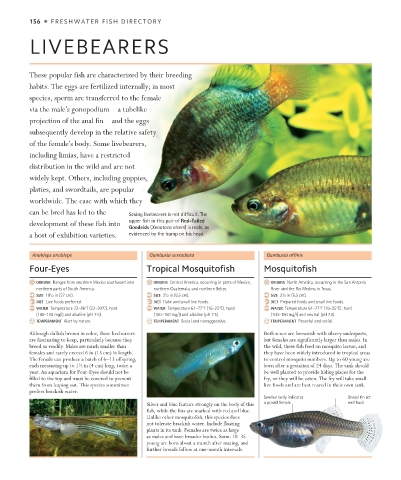
         can be bred has led to the    Sexing livebearers is not difficult. The
         development of these fish into    upper fish in this pair of Red-Tailed
                                     Goodeids (Xenotoca eiseni) is male, as
         a host of exhibition varieties.  evidenced by the hump on his head.

          Anableps anableps               Gambusia sexradiata             Gambusia affinis
         Four-Eyes                       Tropical Mosquitofish            Mosquitofish

           ORIGINS  Ranges from southern Mexico southward into   ORIGINS  Central America, occurring in parts of Mexico,   ORIGINS  North America, occurring in the San Antonio
           northern parts of South America.   northern Guatemala, and northern Belize.  River and the Rio Medina in Texas.
           SIZE  10 ⁄2 in (27 cm).         SIZE  2 ⁄2 in (6.5 cm).          SIZE  2 ⁄2 in (6.5 cm).
                                                                               1
               1
                                               1
           DIET  Live foods preferred.     DIET  Flake and small live foods.  DIET  Prepared foods and small live foods.
           WATER  Temperature 72–86°F (22–30°C); hard   WATER  Temperature 61–77°F (16–25°C); hard    WATER  Temperature 61–77°F (16–25°C); hard
           (100–150 mg/l) and alkaline (pH 7.5).   (100–150 mg/l) and alkaline (pH 7.5).   (100–150 mg/l) and neutral (pH 7.0).
           TEMPERAMENT  Alert by nature.   TEMPERAMENT  Social and nonaggressive.  TEMPERAMENT  Peaceful and social.
         Although dullish brown in color, these livebearers               Both sexes are brownish with silvery underparts,
         are fascinating to keep, particularly because they               but females are significantly larger than males. In
         breed so readily. Males are much smaller than                    the wild, these fish feed on mosquito larvae, and
         females and rarely exceed 6 in (15 cm) in length.                they have been widely introduced in tropical areas
         The female can produce a batch of 6–13 offspring,                to control mosquito numbers. Up to 60 young are
         each measuring up to 1 ⁄2 in (4 cm) long, twice a                born after a gestation of 24 days. The tank should
                       1
         year. An aquarium for Four-Eyes should not be                    be well planted to provide hiding places for the
         filled to the top and must be covered to prevent                 fry, or they will be eaten. The fry will take small
         them from leaping out. This species sometimes                    live foods and are best reared in their own tank.
         prefers brackish water.
                                                                          Swollen belly indicates   Dorsal fin set
                                         Silver and blue feature strongly on the body of this   a gravid female  well back
                                         fish, while the fins are marked with red and blue.
                                         Unlike other mosquitofish, this species does
                                         not tolerate brackish water. Include floating
                                         plants in its tank. Females are twice as large
                                         as males and have broader bodies. Some 10 –35
                                         young are born about a month after mating, and
                                         further broods follow at one-month intervals.


   US_156-157_Live_bearers_Intro.indd   156                                                          29/08/18   4:09 PM

