


Page 180 - Encyclopedia of Aquarium and Pond Fish, 3rd Edition
P. 180
178    FRESHWATER FISH DIRECTORY


          Melanotaenia boesemani
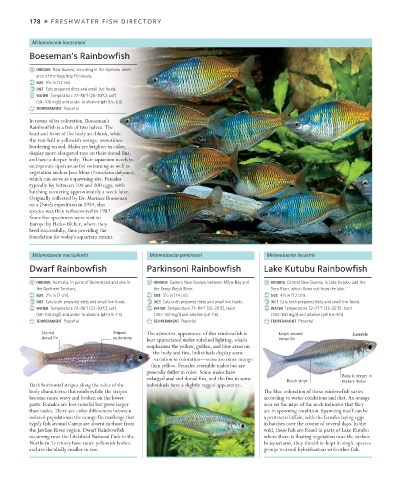
         Boeseman’s Rainbowfish

           ORIGINS  New Guinea, occurring in the Ajamaru Lakes
           area of the Vogelkop Peninsula.
           SIZE  4 ⁄4 in (12 cm).
              3
           DIET  Eats prepared diets and small live foods.
           WATER  Temperature 77–86°F (25–30°C); soft
           (50–100 mg/l) and acidic to alkaline (pH 6.5–8.0).
           TEMPERAMENT  Peaceful.
         In terms of its coloration, Boeseman’s
         Rainbowfish is a fish of two halves. The
         head and front of the body are bluish, while
         the rear half is yellowish-orange, sometimes
         bordering on red. Males are brighter in color,
         display more elongated rays on their dorsal fins,
         and have a deeper body. Their aquarium needs to
         incorporate open areas for swimming as well as
         vegetation such as Java Moss (Vesicularia dubyana),
         which can serve as a spawning site. Females
         typically lay between 100 and 200 eggs, with
         hatching occurring approximately a week later.
         Originally collected by Dr. Marinus Boeseman
         on a Dutch expedition in 1954, this
         species was then rediscovered in 1982.
         Some live specimens were sent to
         Europe by Heiko Bleher, where they
         bred successfully, thus providing the
         foundation for today’s aquarium strains.

          Melanotaenia maccullochi        Melanotaenia parkinsoni         Melanotaenia lacustris
         Dwarf Rainbowfish               Parkinsoni Rainbowfish           Lake Kutubu Rainbowfish

           ORIGINS  Australia, in parts of Queensland and also in   ORIGINS  Eastern New Guinea, between Milne Bay and   ORIGINS  Central New Guinea, in Lake Kutubu and the
           the Northern Territory.         the Kemp Welsh River.            Soro River, which flows out from the lake.
           SIZE  2 ⁄4 in (7 cm).           SIZE  5 ⁄2 in (14 cm).           SIZE  4 ⁄4 in (12 cm).
                                                                               3
              3
                                               1
           DIET  Eats both prepared diets and small live foods.  DIET  Eats both prepared diets and small live foods.  DIET  Eats both prepared diets and small live foods.
           WATER  Temperature 72–86°F (22–30°C); soft   WATER  Temperature 77–84°F (25–29°C); hard    WATER  Temperature 72–77°F (22–25°C); hard
           (50–100 mg/l) and acidic to alkaline (pH 5.5–7.5).  (100–150 mg/l) and alkaline (pH 7.6).   (100–150 mg/l) and alkaline (pH 8.0–9.0).
           TEMPERAMENT  Peaceful.          TEMPERAMENT  Peaceful.           TEMPERAMENT  Peaceful.
            Second              Striped   The attractive appearance of this rainbowfish is   Larger second   Juvenile
            dorsal fin          patterning  best appreciated under subdued lighting, which   dorsal fin
                                         emphasizes the yellow, golden, and blue areas on
                                           the body and fins. Individuals display some
                                           variation in coloration—some are more orange
                                           than yellow. Females resemble males but are
                                         generally duller in color. Some males have
                                         enlarged anal and dorsal fins, and the fins in some    Bluish stripe  Body is deeper in
                                                                                               mature males
         Dark horizontal stripes along the sides of the    individuals have a slightly ragged appearance.
         body characterize this rainbowfish; the stripes                  The blue coloration of these rainbowfish varies
         become more wavy and broken on the lower                         according to water conditions and diet. An orange
         parts. Females are less colorful but grow larger                 area on the nape of the neck indicates that they
         than males. There are color differences between                  are in spawning condition. Spawning itself can be
         isolated populations; the orange fin markings that               a protracted affair, with the females laying eggs
         typify fish around Cairns are absent in those from               in batches over the course of several days. In the
         the Jardine River region. Dwarf Rainbowfish                      wild, these fish are found in parts of Lake Kutubu
         occurring near the Litchfield National Park in the               where there is floating vegetation near the surface.
         Northern Territory have more yellowish bodies                    In aquariums, they should be kept in single-species
         and are decidedly smaller in size.                               groups to avoid hybridization with other fish.


   US_178-179_Melanotaenia_sp.indd   178                                                             29/08/18   4:10 PM

