


Page 181 - Encyclopedia of Aquarium and Pond Fish, 3rd Edition
P. 181
RAINBOWFISH/MELANOTAENIA SPECIES    179


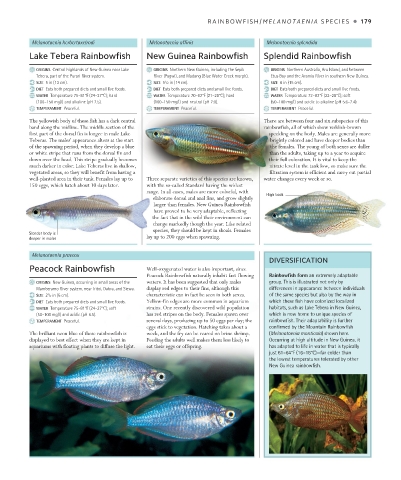
          Melanotaenia herbertaxelrodi    Melanotaenia affinis            Melanotaenia splendida
         Lake Tebera Rainbowfish         New Guinea Rainbowfish           Splendid Rainbowfish

           ORIGINS  Central highlands of New Guinea near Lake   ORIGINS  Northern New Guinea, including the Sepik   ORIGINS  Northern Australia, Aru Island, and between
           Tebera, part of the Purari River system.  River (Pagwi), and Madang (Blue Water Creek morph).  Etus Bay and the Aramia River in southern New Guinea.
           SIZE  5 in (13 cm).             SIZE  5 ⁄2 in (14 cm).           SIZE  6 in (15 cm).
                                               1
           DIET  Eats both prepared diets and small live foods.  DIET  Eats both prepared diets and small live foods.  DIET  Eats both prepared diets and small live foods.
           WATER  Temperature 75–81°F (24–27°C); hard    WATER  Temperature 70–82°F (21–28°C); hard    WATER  Temperature 72–82°F (22–28°C); soft
           (100–150 mg/l) and alkaline (pH 7.5).  (100–150 mg/l) and neutral (pH 7.0).  (50–100 mg/l) and acidic to alkaline (pH 5.6–7.4).
           TEMPERAMENT  Peaceful.          TEMPERAMENT  Peaceful.           TEMPERAMENT  Peaceful.
         The yellowish body of these fish has a dark central              There are between four and six subspecies of this
         band along the midline. The middle section of the                rainbowfish, all of which show reddish-brown
         first part of the dorsal fin is longer in male Lake               speckling on the body. Males are generally more
         Teberas. The males’ appearance alters at the start                 brightly colored and have deeper bodies than
         of the spawning period, when they develop a blue                   the females. The young of both sexes are duller
         or white stripe that runs from the dorsal fin and                 than the adults, taking up to a year to acquire
         down over the head. This stripe gradually becomes                 their full coloration. It is vital to keep the
         much darker in color. Lake Teberas live in shallow,               nitrate level in the tank low, so make sure the
         vegetated areas, so they will benefit from having a               filtration system is efficient and carry out partial
         well-planted area in their tank. Females lay up to   Three separate varieties of this species are known,   water changes every week or so.
         150 eggs, which hatch about 10 days later.  with the so-called Standard having the widest
                                         range. In all cases, males are more colorful, with   High back
                                           elaborate dorsal and anal fins, and grow slightly
                                           larger than females. New Guinea Rainbowfish
                                           have proved to be very adaptable, reflecting
                                           the fact that in the wild their environment can
                                           change markedly though the year. Like related
                                           species, they should be kept in shoals. Females
         Slender body is
         deeper in males                 lay up to 200 eggs when spawning.
          Melanotaenia praecox
                                                                           DIVERSIFICATION
         Peacock Rainbowfish             Well-oxygenated water is also important, since
                                         Peacock Rainbowfish naturally inhabit fast-flowing   Rainbowfish form an extremely adaptable
           ORIGINS  New Guinea, occurring in small areas of the   waters. It has been suggested that only males   group. This is illustrated not only by
           Mamberamo River system, near Iritoi, Dabra, and Siewa.  display red edges to their fins, although this   differences in appearance between individuals
           SIZE  2 ⁄2 in (6 cm).         characteristic can in fact be seen in both sexes.   of the same species but also by the way in
              1
           DIET  Eats both prepared diets and small live foods.  Yellow-fin edges are more common in aquarium   which these fish have colonized localized
           WATER  Temperature 75–81°F (24–27°C); soft    strains. One recently discovered wild population   habitats, such as Lake Tebera in New Guinea,
           (50–100 mg/l) and acidic (pH 6.5).  has red stripes on the body. Females spawn over   which is now home to unique species of
           TEMPERAMENT  Peaceful.        several days, producing up to 50 eggs per day; the   rainbowfish. Their adaptability is further
                                         eggs stick to vegetation. Hatching takes about a   confirmed by the Mountain Rainbowfish
         The brilliant neon blue of these rainbowfish is   week, and the fry can be reared on brine shrimp.    (Melanotaenia monticola) shown here.
         displayed to best effect when they are kept in   Feeding the adults well makes them less likely to   Occurring at high altitude in New Guinea, it
         aquariums with floating plants to diffuse the light.   eat their eggs or offspring.  has adapted to life in water that is typically
                                                                           just 61–64°F (16–18°C)—far colder than
                                                                           the lowest temperatures tolerated by other
                                                                           New Guinea rainbowfish.


   US_178-179_Melanotaenia_sp.indd   179                                                             29/08/18   4:10 PM

