


Page 182 - Encyclopedia of Aquarium and Pond Fish, 3rd Edition
P. 182
180    FRESHWATER FISH DIRECTORY

         LOACHES


         Often confused with catfish, loaches belong to
         the family Cobitidae and occur in both tropical
         and temperate regions. All loaches have barbels
         around the mouth and, even though it is not
         always obvious, a spine below each eye.
         When a loach feels threatened, it will raise
         its spines, making itself more difficult for
         a predator to swallow. The spines can easily
         become entangled in a net, so extra care is
         called for when catching these fish. Loaches
         are mostly shy, nocturnal fish, and so may
         have to be coaxed into view with live foods.

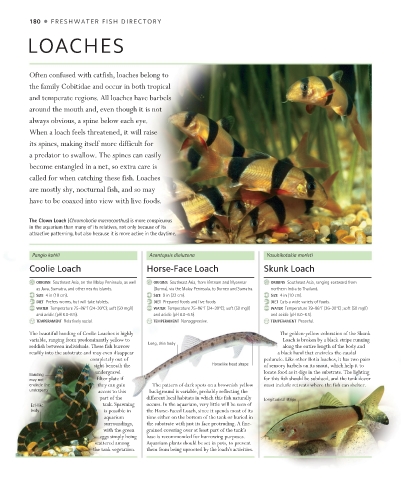
         The Clown Loach (Chromobotia macracanthus) is more conspicuous
         in the aquarium than many of its relatives, not only because of its
         attractive patterning, but also because it is more active in the daytime.

          Pangio kuhlii                   Acantopsis dialuzona            Yasuhikotakia morleti
         Coolie Loach                    Horse-Face Loach                 Skunk Loach

           ORIGINS  Southeast Asia, on the Malay Peninsula, as well   ORIGINS  Southeast Asia, from Vietnam and Myanmar   ORIGINS  Southeast Asia, ranging eastward from
           as Java, Sumatra, and other nearby islands.   (Burma), via the Malay Peninsula, to Borneo and Sumatra.   northern India to Thailand.
           SIZE  4 in (10 cm).             SIZE  9 in (23 cm).              SIZE  4 in (10 cm).
           DIET  Prefers worms, but will take tablets.   DIET  Prepared foods and live foods.  DIET  Eats a wide variety of foods.
           WATER  Temperature 75–86°F (24–30°C); soft (50 mg/l)   WATER  Temperature 75–86°F (24–30°C); soft (50 mg/l)   WATER  Temperature 79–86°F (26–30°C); soft (50 mg/l)
           and acidic (pH 6.0–6.5).        and acidic (pH 6.0–6.5).         and acidic (pH 6.0–6.5).
           TEMPERAMENT  Relatively social.  TEMPERAMENT  Nonaggressive.     TEMPERAMENT  Peaceful.
         The beautiful banding of Coolie Loaches is highly                    The golden-yellow coloration of the Skunk
         variable, ranging from predominantly yellow to   Long, thin body      Loach is broken by a black stripe running
         reddish between individuals. These fish burrow                        along the entire length of the body and
         readily into the substrate and may even disappear                    a black band that encircles the caudal
                          completely out of                               peduncle. Like other Botia loaches, it has two pairs
                           sight beneath the               Horselike head shape  of sensory barbels on its snout, which help it to
                           undergravel                                    locate food as it digs in the substrate. The lighting
         Banding
         may not            filter plate if                               for this fish should be subdued, and the tank decor
         encircle the       they can gain   The pattern of dark spots on a brownish-yellow   must include retreats where the fish can shelter.
         underparts         access to this   background is variable, probably reflecting the
                             part of the   different local habitats in which this fish naturally   Longitudinal stripe
         Eel-like            tank. Spawning   occurs. In the aquarium, very little will be seen of
         body                 is possible in   the Horse-Faced Loach, since it spends most of its
                              aquarium   time either on the bottom of the tank or buried in
                              surroundings,   the substrate with just its face protruding. A fine-
                              with the green   grained covering over at least part of the tank’s
                             eggs simply being   base is recommended for burrowing purposes.
                           scattered among    Aquarium plants should be set in pots, to prevent
                           the tank vegetation.  them from being uprooted by the loach’s activities.


   US_180-181_Loaches.indd   180                                                                     29/08/18   4:10 PM

