


Page 290 - Encyclopedia of Aquarium and Pond Fish, 3rd Edition
P. 290
288    MARINE INVERTEBRATES DIRECTORY

         CORALS


         Corals form the centerpiece of any reef aquarium.
         A coral is a colony of linked organisms called polyps.
         In stony corals, which form the foundation of the reef,
         the polyps have a hard body casing of calcium carbonate,
         while the polyps of soft corals are supported by a less
         rigid calcareous structure. Corals need plenty of space,
         and overcrowding will hinder their growth. Many
         corals contain symbiotic zooxanthellae (algae). When
         the algae photosynthesize, they provide food for both
         themselves and the coral, so good lighting in the tank
         is vital. If a piece of coral breaks off, it can be used to
         establish a new colony elsewhere in the tank.
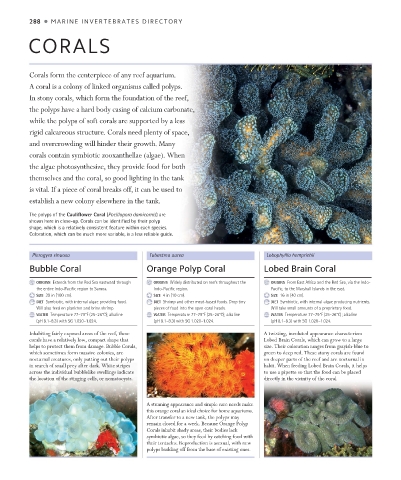
         The polyps of the Cauliflower Coral (Pocillopora damicornis) are
         shown here in close-up. Corals can be identified by their polyp
         shape, which is a relatively consistent feature within each species.
         Coloration, which can be much more variable, is a less reliable guide.

          Plerogyra sinuosa               Tubastrea aurea                 Lobophyllia hemprichii
         Bubble Coral                    Orange Polyp Coral               Lobed Brain Coral

           ORIGINS  Extends from the Red Sea eastward through   ORIGINS  Widely distributed on reefs throughout the   ORIGINS  From East Africa and the Red Sea, via the Indo-
           the entire Indo-Pacific region to Samoa.  Indo-Pacific region.   Pacific, to the Marshall Islands in the east.
           SIZE  39 in (100 cm).           SIZE  4 in (10 cm).              SIZE  16 in (40 cm).
           DIET  Symbiotic, with internal algae providing food.    DIET  Shrimp and other meat-based foods. Drop tiny   DIET  Symbiotic, with internal algae producing nutrients.
           Will also feed on plankton and brine shrimp.  pieces of food into the open coral heads.  Will take small amounts of a proprietary food.
           WATER  Temperature 77–79°F (25–26°C); alkaline   WATER  Temperature 77–79°F (25–26°C); alkaline   WATER  Temperature 77–79°F (25–26°C); alkaline
           (pH 8.1–8.3) with SG 1.020–1.024.  (pH 8.1–8.3) with SG 1.020–1.024.  (pH 8.1–8.3) with SG 1.020–1.024.
         Inhabiting fairly exposed areas of the reef, these               A twisting, involuted appearance characterizes
         corals have a relatively low, compact shape that                 Lobed Brain Corals, which can grow to a large
         helps to protect them from damage. Bubble Corals,                size. Their coloration ranges from grayish-blue to
         which sometimes form massive colonies, are                       green to deep red. These stony corals are found
         nocturnal creatures, only putting out their polyps               on deeper parts of the reef and are nocturnal in
         in search of small prey after dark. White stripes                habit. When feeding Lobed Brain Corals, it helps
         across the individual bubblelike swellings indicate              to use a pipette so that the food can be placed
         the location of the stinging cells, or nematocysts.              directly in the vicinity of the coral.


                                         A stunning appearance and simple care needs make
                                         this orange coral an ideal choice for home aquariums.
                                         After transfer to a new tank, the polyps may
                                         remain closed for a week. Because Orange Polyp
                                         Corals inhabit shady areas, their bodies lack
                                         symbiotic algae, so they feed by catching food with
                                         their tentacles. Reproduction is asexual, with new
                                         polyps budding off from the base of existing ones.


   US_288-289_Corals.indd   288                                                                      29/08/18   4:10 PM

