


Page 291 - Encyclopedia of Aquarium and Pond Fish, 3rd Edition
P. 291
CORALS     289


          Goniopora species
                                           NIGHT BLOOMING
         Flowerpot Coral
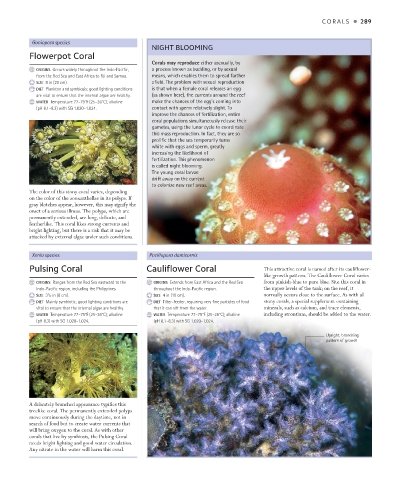
                                           Corals may reproduce either asexually, by
           ORIGINS  Occurs widely throughout the Indo-Pacific,   a process known as budding, or by sexual
           from the Red Sea and East Africa to Fiji and Samoa.  means, which enables them to spread farther
           SIZE  8 in (20 cm).             afield. The problem with sexual reproduction
           DIET  Plankton and symbiosis; good lighting conditions   is that when a female coral releases an egg
           are vital to ensure that the internal algae are healthy.  (as shown here), the currents around the reef
           WATER  Temperature 77–79°F (25–26°C); alkaline   make the chances of the egg’s coming into
           (pH 8.1–8.3) with SG 1.020–1.024.  contact with sperm relatively slight. To
                                           improve the chances of fertilization, entire
                                           coral populations simultaneously release their
                                           gametes, using the lunar cycle to coordinate
                                           this mass reproduction. In fact, they are so
                                           prolific that the sea temporarily turns
                                           white with eggs and sperm, greatly
                                           increasing the likelihood of
                                           fertilization. This phenomenon
                                           is called night blooming.
                                           The young coral larvae
                                           drift away on the current
                                           to colonize new reef areas.
         The color of this stony coral varies, depending
         on the color of the zooxanthellae in its polyps. If
         gray blotches appear, however, this may signify the
         onset of a serious illness. The polyps, which are
         permanently extended, are long, delicate, and
         featherlike. This coral likes strong currents and
         bright lighting, but there is a risk that it may be
         attacked by external algae under such conditions.

          Xenia species                   Pocillopora damicornis
         Pulsing Coral                   Cauliflower Coral                This attractive coral is named after its cauliflower-
                                                                          like growth pattern. The Cauliflower Coral varies
           ORIGINS  Ranges from the Red Sea eastward to the   ORIGINS  Extends from East Africa and the Red Sea   from pinkish-blue to pure blue. Site this coral in
           Indo-Pacific region, including the Philippines.  throughout the Indo-Pacific region.  the upper levels of the tank; on the reef, it
           SIZE  3 ⁄2 in (8 cm).           SIZE  4 in (10 cm).            normally occurs close to the surface. As with all
              1
           DIET  Mainly symbiotic; good lighting conditions are    DIET  Filter-feeder, requiring very fine particles of food   stony corals, a special supplement containing
           vital to ensure that the internal algae are healthy.  that it can sift from the water.  minerals, such as calcium, and trace elements,
           WATER  Temperature 77–79°F (25–26°C); alkaline    WATER  Temperature 77–79°F (25–26°C); alkaline    including strontium, should be added to the water.
           (pH 8.3) with SG 1.020–1.024.   (pH 8.1–8.3) with SG 1.020–1.024.
                                                                                           Upright, branching
                                                                                           pattern of growth


         A delicately branched appearance typifies this
         treelike coral. The permanently extended polyps
         move continuously during the daytime, not in
         search of food but to create water currents that
         will bring oxygen to the coral. As with other
         corals that live by symbiosis, the Pulsing Coral
         needs bright lighting and good water circulation.
         Any nitrate in the water will harm this coral.


   US_288-289_Corals.indd   289                                                                      29/08/18   4:10 PM

