


Page 370 - Encyclopedia of Aquarium and Pond Fish, 3rd Edition
P. 370
368    POND PLANT DIRECTORY


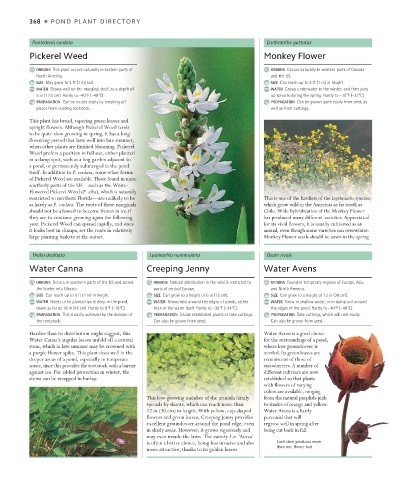
          Pontederia cordata                                              Erythranthe guttatus
         Pickerel Weed                                                    Monkey Flower

           ORIGINS  This plant occurs naturally in eastern parts of         ORIGINS  Occurs naturally in western parts of Canada
           North America.                                                   and the US.
           SIZE  May grow to 3 ft (1 m) tall.                               SIZE  Can reach up to 3 ft (1 m) in height.
           WATER  Grows well on the marginal shelf, to a depth of           WATER  Grows underwater in the winter, and then puts
           5 in (12.5 cm). Hardy to –40°F (–40°C).                          up sprouts during the spring. Hardy to –10°F (–23°C).
           PROPAGATION  Can be rooted easily by breaking off                PROPAGATION  Can be grown quite easily from seed, as
           pieces from existing rootstock.                                  well as from cuttings.
         This plant has broad, tapering green leaves and
         upright flowers. Although Pickerel Weed tends
         to be quite slow growing in spring, it has a long
         flowering period that lasts well into late summer,
         when other plants are finished blooming. Pickerel
         Weed prefers a position in full sun, either planted
         in a damp spot, such as a bog garden adjacent to
         a pond, or permanently submerged in the pond
         itself. In addition to P. cordata, some other forms
         of Pickerel Weed are available. Those found in more
         southerly parts of the US—such as the White-
         Flowered Pickerel Weed (P. alba), which is naturally
         restricted to northern Florida—are unlikely to be                This is one of the hardiest of the Erythranthe species,
         as hardy as P. cordata. The roots of these marginals             which grow wild in the Americas as far south as
         should not be allowed to become frozen in ice if                 Chile. Wide hybridization of the Monkey Flower
         they are to continue growing again the following                 has produced many different varieties. Appreciated
         year. Pickerel Weed can spread rapidly, and since                for its vivid flowers, it is usually cultivated as an
         it looks best in clumps, set the roots in relatively             annual, even though some varieties can overwinter.
         large planting baskets at the outset.                            Monkey Flower seeds should be sown in the spring.

          Thalia dealbata                 Lysimachia nummularia           Geum rivale
         Water Canna                     Creeping Jenny                   Water Avens

           ORIGINS  Occurs in southern parts of the US and across   ORIGINS  Natural distribution in the wild is restricted to   ORIGINS  Found in temperate regions of Europe, Asia,
           the border into Mexico.         parts of central Europe.         and North America.
           SIZE  Can reach up to 6 ft (2 m) in height.  SIZE  Can grow to a height of 6 in (15 cm).  SIZE  Can grow to a height of 12 in (30 cm).
           WATER  Needs to be planted quite deep in the pond,   WATER  Grows best around the edges of ponds, rather   WATER  Grow in shallow water, or in damp soil around
           down as far as 18 in (45 cm). Hardy to 0°F (–18°C).  than in the water itself. Hardy to –30°F (–34°C).  the edges of the pond. Hardy to –40°F (–40°C).
           PROPAGATION  This is easily achieved by the division of   PROPAGATION  Divide established plants or take cuttings.   PROPAGATION  Take cuttings, which will root easily.
           the rootstock.                  Can also be grown from seed.     Can also be grown from seed.
         Hardier than its distribution might suggest, this                Water Avens is a good choice
         Water Canna’s angular leaves unfold off a central                for the surroundings of a pond,
         stem, which in late summer may be crowned with                   where low groundcover is
         a purple flower spike. This plant does well in the               needed. Its green leaves are
         deeper areas of a pond, especially in temperate                  reminiscent of those of
         zones, since this provides the rootstock with a barrier          strawberries. A number of
         against ice. For added protection in winter, the                 different cultivars are now
         stems can be wrapped in burlap.                                  established so that plants
                                                                          with flowers of varying
                                                                          colors are available, ranging
                                         This low-growing member of the primula family   from the natural purplish-pink
                                         spreads by shoots, which can reach more than    to shades of orange and yellow.
                                         12 in (30 cm) in length. With yellow, cup-shaped   Water Avens is a hardy
                                         flowers and green leaves, Creeping Jenny provides   perennial that will
                                         excellent groundcover around the pond edge, even   regrow well in spring after
                                         in shady areas. However, it grows vigorously and   being cut back in fall.
                                         may even invade the lawn. The variety L.n. ‘Aurea’
                                         is often a better choice, being less invasive and also   Each stem produces more
                                         more attractive, thanks to its golden leaves.  than one flower bud


   US_368-369_Marginals_3.indd   368                                                                 29/08/18   4:11 PM

