


Page 371 - Encyclopedia of Aquarium and Pond Fish, 3rd Edition
P. 371
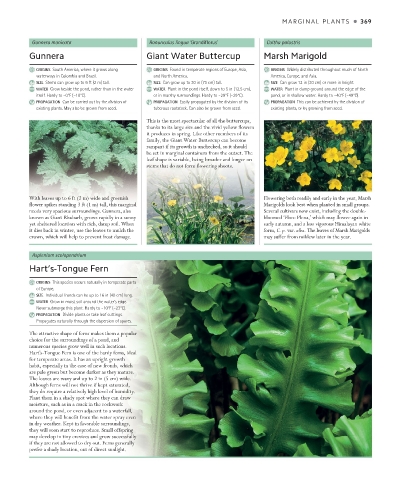
MARGINAL PLANTS     369


          Gunnera manicata                Ranunculus lingua ‘Grandiflorus’  Caltha palustris
         Gunnera                         Giant Water Buttercup            Marsh Marigold

           ORIGINS  South America, where it grows along   ORIGINS  Found in temperate regions of Europe, Asia,   ORIGINS  Widely distributed throughout much of North
           waterways in Colombia and Brazil.  and North America.            America, Europe, and Asia.
           SIZE  Stems can grow up to 6 ft (2 m) tall.   SIZE  Can grow up to 30 in (75 cm) tall.  SIZE  Can grow 12 in (30 cm) or more in height.
           WATER  Grow beside the pond, rather than in the water   WATER  Plant in the pond itself, down to 5 in (12.5 cm),   WATER  Plant in damp ground around the edge of the
           itself. Hardy to –0°F (–18°C).  or in marshy surroundings. Hardy to –20°F (–29°C).  pond, or in shallow water. Hardy to –40°F (–40°C).
           PROPAGATION  Can be carried out by the division of   PROPAGATION  Easily propagated by the division of its   PROPAGATION  This can be achieved by the division of
           existing plants. May also be grown from seed.  tuberous rootstock. Can also be grown from seed.  existing plants, or by growing from seed.
                                         This is the most spectacular of all the buttercups,
                                         thanks to its large size and the vivid yellow flowers
                                         it produces in spring. Like other members of its
                                         family, the Giant Water Buttercup can become
                                         rampant if its growth is unchecked, so it should
                                         be set in marginal containers from the outset. The
                                         leaf shape is variable, being broader and longer on
                                         stems that do not form flowering shoots.


         With leaves up to 6 ft (2 m) wide and greenish                   Flowering both readily and early in the year, Marsh
         flower spikes standing 3 ft (1 m) tall, this marginal            Marigolds look best when planted in small groups.
         needs very spacious surroundings. Gunnera, also                  Several cultivars now exist, including the double-
         known as Giant Rhubarb, grows rapidly in a sunny                 bloomed ‘Flore Plena,’ which may flower again in
         yet sheltered location with rich, damp soil. When                early autumn, and a less vigorous Himalayan white
         it dies back in winter, use the leaves to mulch the              form, C. p. var. alba. The leaves of Marsh Marigolds
         crown, which will help to prevent frost damage.                  may suffer from mildew later in the year.

          Asplenium scolopendrium
         Hart’s-Tongue Fern

           ORIGINS  This species occurs naturally in temperate parts
           of Europe.
           SIZE  Individual fronds can be up to 16 in (40 cm) long.
           WATER  Grow in moist soil around the water’s edge.
           Never submerge this plant. Hardy to –10°F ( –23°C).
           PROPAGATION  Divide plants or take leaf cuttings.
           Propagates naturally through the dispersion of spores.
         The attractive shape of ferns makes them a popular
         choice for the surroundings of a pond, and
         numerous species grow well in such locations.
         Hart’s-Tongue Fern is one of the hardy ferns, ideal
         for temperate areas. It has an upright growth
         habit, especially in the case of new fronds, which
         are pale green but become darker as they mature.
         The leaves are wavy and up to 2 in (5 cm) wide.
         Although ferns will not thrive if kept saturated,
         they do require a relatively high level of humidity.
         Plant them in a shady spot where they can draw
         moisture, such as in a crack in the rockwork
         around the pond, or even adjacent to a waterfall,
         where they will benefit from the water spray even
         in dry weather. Kept in favorable surroundings,
         they will soon start to reproduce. Small offspring
         may develop in tiny crevices and grow successfully
         if they are not allowed to dry out. Ferns generally
         prefer a shady location, out of direct sunlight.


   US_368-369_Marginals_3.indd   369                                                                 29/08/18   4:11 PM

