


Page 369 - Encyclopedia of Aquarium and Pond Fish, 3rd Edition
P. 369
MARGINAL PLANTS     367


          Iris ensata                                                     Iris pseudacorus
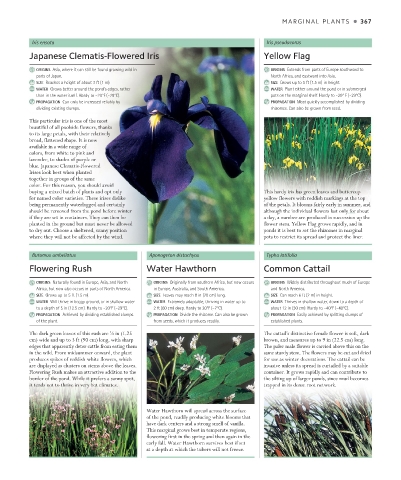
         Japanese Clematis-Flowered Iris                                  Yellow Flag

           ORIGINS  Asia, where it can still be found growing wild in       ORIGINS  Extends from parts of Europe southward to
           parts of Japan.                                                  North Africa, and eastward into Asia.
           SIZE  Reaches a height of about 3 ft (1 m).                      SIZE  Grows up to 5 ft (1.5 m) in height.
           WATER  Grows better around the pond’s edges, rather              WATER  Plant either around the pond or in submerged
           than in the water itself. Hardy to –20°F (–29°C).                pots on the marginal shelf. Hardy to –20° F (–29°C).
           PROPAGATION  Can only be increased reliably by                   PROPAGATION  Most quickly accomplished by dividing
           dividing existing clumps.                                        rhizomes. Can also be grown from seed.
         This particular iris is one of the most
         beautiful of all poolside flowers, thanks
         to its large petals, with their relatively
         broad, flattened shape. It is now
         available in a wide range of
         colors, from white to pink and
         lavender, to shades of purple or
         blue. Japanese Clematis-Flowered
         Irises look best when planted
         together in groups of the same
         color. For this reason, you should avoid
         buying a mixed batch of plants and opt only                      This hardy iris has green leaves and buttercup-
         for named color varieties. These irises dislike                  yellow flowers with reddish markings at the top
         being permanently waterlogged and certainly                      of the petals. It blooms fairly early in summer, and
         should be removed from the pond before winter                    although the individual flowers last only for about
         if they are set in containers. They can then be                  a day, a number are produced in succession up the
         planted in the ground but must never be allowed                  flower stem. Yellow Flag grows rapidly, and in
         to dry out. Choose a sheltered, sunny position                   ponds it is best to set the rhizomes in marginal
         where they will not be affected by the wind.                     pots to restrict its spread and protect the liner.

          Butomus umbellatus              Aponogeton distachyos           Typha latifolia
         Flowering Rush                  Water Hawthorn                   Common Cattail

           ORIGINS  Naturally found in Europe, Asia, and North   ORIGINS  Originally from southern Africa, but now occurs   ORIGINS  Widely distributed throughout much of Europe
           Africa, but now also occurs in parts of North America.   in Europe, Australia, and South America.  and North America.
           SIZE  Grows up to 5 ft (1.5 m).  SIZE  Leaves may reach 8 in (20 cm) long.  SIZE  Can reach 6 ft (2 m) in height.
           WATER  Will thrive in boggy ground, or in shallow water   WATER  Extremely adaptable, thriving in water up to    WATER  Thrives in shallow water, down to a depth of
           to a depth of 5 in (12.5 cm). Hardy to –20°F (–29°C).  2 ft (60 cm) deep. Hardy to 20°F (–7°C).  about 12 in (30 cm). Hardy to –40°F (–40°C).
           PROPAGATION  Achieved by dividing established clumps   PROPAGATION  Divide the rhizome. Can also be grown   PROPAGATION  Easily achieved by splitting clumps of
           of the plant.                   from seeds, which it produces readily.  established plants.
                               1
         The dark green leaves of this rush are  ⁄2 in (1.25              The cattail’s distinctive female flower is soft, dark
         cm) wide and up to 3 ft (90 cm) long, with sharp                 brown, and measures up to 9 in (22.5 cm) long.
         edges that apparently deter cattle from eating them              The paler male flower is carried above this on the
         in the wild. From midsummer onward, the plant                    same sturdy stem. The flowers may be cut and dried
         produces spikes of reddish-white flowers, which                  for use as winter decorations. The cattail can be
         are displayed as clusters on stems above the leaves.             invasive unless its spread is curtailed by a suitable
         Flowering Rush makes an attractive addition to the               container. It grows rapidly and can contribute to
         border of the pond. While it prefers a sunny spot,               the silting up of larger ponds, since mud becomes
         it tends not to thrive in very hot climates.                     trapped in its dense root network.


                                         Water Hawthorn will spread across the surface
                                         of the pond, readily producing white blooms that
                                         have dark centers and a strong smell of vanilla.
                                         This marginal grows best in temperate regions,
                                         flowering first in the spring and then again in the
                                         early fall. Water Hawthorn survives best if set
                                         at a depth at which the tubers will not freeze  .


   US_366-367_Marginals_2.indd   367                                                                14/09/18   12:07 PM

