


Page 64 - Encyclopedia of Aquarium and Pond Fish, 3rd Edition
P. 64
62    FRESHWATER FISH: BREEDING

                                                          during which time the adult fish does not feed. The fry emerge
                                                          from their parent’s mouth when they are able to swim freely.
                                                          Mouth-brooding is best documented in members of the cichlid
                                                          family, but it also occurs in some bettas and catfish. These fish
                                                          produce far fewer eggs than other egg-layers, but their eggs
                                                          stand a better chance of survival.
                                                          Survival of the fry
                                                          Fry that hatch in the open initially lie largely immobile, close
                                                          to where they hatched, until they have digested the remains
                                                          of their yolk sac—a process that may last several days. Many
                                                          species that guard their eggs also show parental care toward
                                                             their fry. Some cichlids, for example, herd their offspring
                                                             into spawning pits that they excavate in the substrate,
                                                             where they can keep watch over the brood. Several such
                                                            spawning pits may be dug and used during the early days
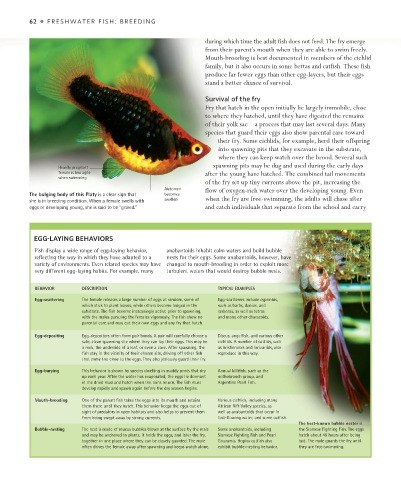
                 Heavily pregnant
                 female is less agile                     after the young have hatched. The combined tail movements
                 when swimming
                                                          of the fry set up tiny currents above the pit, increasing the
                                              Abdomen     flow of oxygen-rich water over the developing young. Even
         The bulging body of this Platy is a clear sign that    becomes
         she is in breeding condition. When a female swells with   swollen  when the fry are free-swimming, the adults will chase after
         eggs or developing young, she is said to be “gravid.”  and catch individuals that separate from the school and carry


          EGG-LAYING BEHAVIORS
           Fish display a wide range of egg-laying behavior,   anabantoids inhabit calm waters and build bubble
           reflecting the way in which they have adapted to a   nests for their eggs. Some anabantoids, however, have
           variety of environments. Even related species may have   changed to mouth-brooding in order to exploit more
           very different egg-laying habits. For example, many   turbulent waters that would destroy bubble nests.

           BEHAVIOR     DESCRIPTION                          TYPICAL EXAMPLES
           Egg-scattering  The female releases a large number of eggs at random, some of   Egg-scatterers include cyprinids,
                        which stick to plant leaves, while others become lodged in the   such as barbs, danios, and
                        substrate. The fish become increasingly active prior to spawning,   rasboras, as well as tetras
                        with the males pursuing the females vigorously. The fish show no   and many other characoids.
                        parental care and may eat their own eggs and any fry that hatch.
           Egg-depositing  Egg-depositors often form pair bonds. A pair will carefully choose a   Discus, angelfish, and various other
                        safe, clean spawning site where they can lay their eggs. This may be   cichlids. A number of catfish, such
                        a rock, the underside of a leaf, or even a cave. After spawning, the   as bristlenoses and loricariids, also
                        fish stay in the vicinity of their chosen site, driving off other fish   reproduce in this way.
                        that come too close to the eggs. They also jealously guard their fry.
           Egg-burying  This behavior is shown by species dwelling in muddy pools that dry   Annual killifish, such as the
                        up each year. After the water has evaporated, the eggs lie dormant   nothobranch group, and
                        in the dried mud and hatch when the rains return. The fish must   Argentine Pearl Fish.
                        develop rapidly and spawn again before the dry season begins.
           Mouth-brooding  One of the parent fish takes the eggs into its mouth and retains   Various cichlids, including many
                        them there until they hatch. This behavior keeps the eggs out of   African Rift Valley species, as
                        sight of predators in open habitats and also helps to prevent them   well as anabantoids that occur in
                        from being swept away by strong currents.  fast-flowing water, and some catfish.
                                                                                   The best-known bubble nester is
           Bubble-nesting  The nest is made of mucus bubbles blown at the surface by the male   Some anabantoids, including   the Siamese Fighting Fish. The eggs
                        and may be anchored to plants. It holds the eggs, and later the fry,   Siamese Fighting Fish and Pearl   hatch about 48 hours after being
                        together in one place where they can be closely guarded. The male   Gouramis. Hoplos catfish also   laid. The male guards the fry until
                        often drives the female away after spawning and keeps watch alone.  exhibit bubble-nesting behavior.  they are free-swimming.


   US_060-063_Reproductive_Behav.indd   62                                                           29/08/18   4:08 PM

