


Page 65 - Encyclopedia of Aquarium and Pond Fish, 3rd Edition
P. 65
REPRODUCTIVE BEHAVIOR    63

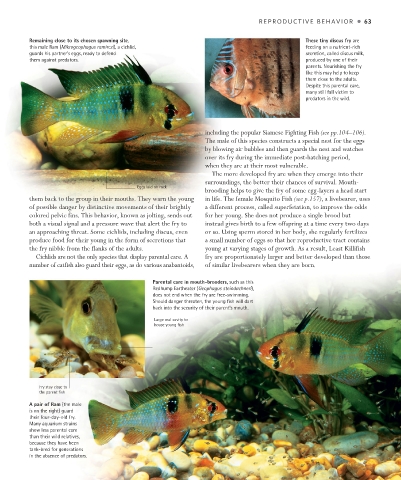
         Remaining close to its chosen spawning site,                                These tiny discus fry are
         this male Ram (Mikrogeophagus ramirezi), a cichlid,                         feeding on a nutrient-rich
         guards his partner’s eggs, ready to defend                                  secretion, called discus milk,
         them against predators.                                                     produced by one of their
                                                                                     parents. Nourishing the fry
                                                                                     like this may help to keep
                                                                                     them close to the adults.
                                                                                     Despite this parental care,
                                                                                     many still fall victim to
                                                                                     predators in the wild.


                                                          including the popular Siamese Fighting Fish (see pp.104 –106).
                                                          The male of this species constructs a special nest for the eggs
                                                          by blowing air bubbles and then guards the nest and watches
                                                          over its fry during the immediate post-hatching period,
                                                          when they are at their most vulnerable.
                                                           The more developed fry are when they emerge into their
                                                          surroundings, the better their chances of survival. Mouth-
                                       Eggs laid on rock
                                                          brooding helps to give the fry of some egg-layers a head start
         them back to the group in their mouths. They warn the young   in life. The female Mosquito Fish (see p.157), a livebearer, uses
         of possible danger by distinctive movements of their brightly   a different process, called superfetation, to improve the odds
         colored pelvic fins. This behavior, known as jolting, sends out   for her young. She does not produce a single brood but
         both a visual signal and a pressure wave that alert the fry to    instead gives birth to a few offspring at a time every two days
         an approaching threat. Some cichlids, including discus, even   or so. Using sperm stored in her body, she regularly fertilizes
         produce food for their young in the form of secretions that    a small number of eggs so that her reproductive tract contains
         the fry nibble from the flanks of the adults.    young at varying stages of growth. As a result, Least Killifish
           Cichlids are not the only species that display parental care. A   fry are proportionately larger and better developed than those
         number of catfish also guard their eggs, as do various anabantoids,   of similar livebearers when they are born.

                                           Parental care in mouth-brooders, such as this
                                           Redhump Eartheater (Geophagus steindachneri),
                                           does not end when the fry are free-swimming.
                                           Should danger threaten, the young fish will dart
                                           back into the security of their parent’s mouth.
                                            Large oral cavity to
                                            house young fish


            Fry stay close to
            the parent fish
         A pair of Ram (the male
         is on the right) guard
         their four-day-old fry.
         Many aquarium strains
         show less parental care
         than their wild relatives,
         because they have been
         tank-bred for generations
         in the absence of predators.


   US_060-063_Reproductive_Behav.indd   63                                                           29/08/18   4:08 PM

