


Page 84 - Encyclopedia of Aquarium and Pond Fish, 3rd Edition
P. 84
82    FRESHWATER FISH DIRECTORY


          Pethia conchonius
         Rosy Barb                       a day; the fry become free-swimming after a
                                         further two or three days. Rosy Barbs can be
           ORIGINS  Asia, where it occurs in northern India, in areas   reared on commercial foods formulated for egg-
           including Assam and Bengal.   layers. Their relative hardiness means that they
           SIZE  6 in (15 cm).           can be housed in well-planted outdoor ponds in
           DIET  Prepared foods and live foods.  subtropical and tropical parts of the world. There
           WATER  Temperature 64–77°F (18–25°C); hard   is likely to be enough natural food in the pond to
           (100–150 mg/l) and around neutral (pH 7.0).   nourish the young fry at first, and they are soon
           TEMPERAMENT  Peaceful and social.  able to take food provided
                                         for the adult fish.
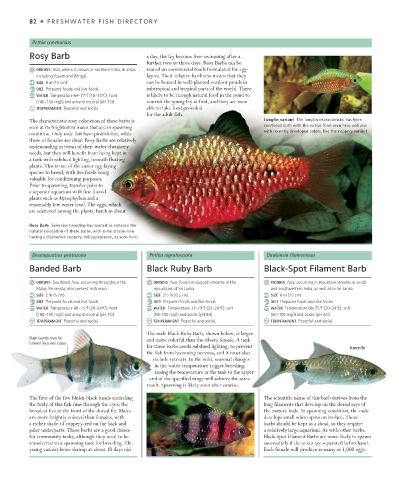
         The characteristic rosy coloration of these barbs is             Longfin variant  The longfin characteristic has been
         seen at its brightest in males that are in spawning              combined both with the native form seen here and also
         condition. Only male fish have pinkish fins, while               with recently developed colors, like the coppery variant.
         those of females are clear. Rosy Barbs are relatively
         undemanding in terms of their water chemistry
         needs, but they will benefit from being kept in
         a tank with subdued lighting, beneath floating
         plants. This is one of the easier egg-laying
         species to breed, with live foods being
         valuable for conditioning purposes.
         Prior to spawning, transfer pairs to
         a separate aquarium with fine-leaved
         plants such as Myriophyllum and a
         reasonably low water level. The eggs, which
         are scattered among the plants, hatch in about
         Rosy Barb  Selective breeding has tended to enhance the
         natural coloration of these barbs, with some strains now
         having a distinctive coppery-red appearance, as seen here.

          Desmopuntius pentazona          Pethia nigrofasciata            Dawkinsia filamentosa
         Banded Barb                     Black Ruby Barb                  Black-Spot Filament Barb

           ORIGINS  Southeast Asia, occurring throughout the   ORIGINS  Asia, found in sluggish streams in the   ORIGINS  Asia, occurring in mountain streams in south
           Malay Peninsula; also present in Borneo.   mountains of Sri Lanka.  and southwestern India, as well as in Sri Lanka.
           SIZE  2 in (5 cm).              SIZE  2 ⁄2 in (6.5 cm).          SIZE  6 in (15 cm).
                                               1
           DIET  Prepared foods and live foods.  DIET  Prepared foods and live foods.  DIET  Prepared foods and live foods.
           WATER  Temperature 68–75°F (20–24°C); hard    WATER  Temperature 72–79°F (22–26°C); soft   WATER  Temperature 68–75°F (20–24°C); soft
           (100–150 mg/l) and around neutral (pH 7.0).   (50–100 mg/l) and acidic (pH 6.0).   (50–100 mg/l) and acidic (pH 6.0).
           TEMPERAMENT  Peaceful and social.  TEMPERAMENT  Peaceful and social.  TEMPERAMENT  Peaceful and social.
                                         The male Black Ruby Barb, shown below, is larger
         Dark bands may be               and more colorful than the silvery female. A tank
         broken in some cases
                                         for these barbs needs subdued lighting, to prevent      Juvenile
                                         the fish from becoming nervous, and it must also
                                           include retreats. In the wild, seasonal changes
                                            in the water temperature trigger breeding;
                                            raising the temperature in the tank to the upper
                                          end of the specified range will achieve the same
                                         result. Spawning is likely soon after sunrise.
         The first of the five bluish-black bands encircling              The scientific name of this barb derives from the
         the body of this fish runs through the eyes; the                 long filaments that develop on the dorsal rays of
         broadest lies at the front of the dorsal fin. Males              the mature male. In spawning condition, the male
         are more brightly colored than females, with                     develops small white spots on its face. These
         a richer shade of coppery-red on the back and                    barbs should be kept as a shoal, so they require
         paler underparts. These barbs are a good choice                  a relatively large aquarium. As with other barbs,
         for community tanks, although they need to be                    Black-Spot Filament Barbs are more likely to spawn
         transferred to a spawning tank for breeding. The                 successfully if the sexes are separated beforehand.
         young can eat brine shrimp at about 10 days old.                 Each female will produce as many as 1,000 eggs.


   US_082-083_Barbs1.indd   82                                                                       29/08/18   4:09 PM

