


Page 15 - The Book of Caterpillars: A Life-Size Guide to Six Hundred Species From Around the World
P. 15
WHAT IS A CATERPILLAR?


            Adaptation to such different environments has led to extraordinary

            diversity in appearance and survival strategies. More than half of all species
            are relatively unstudied “microlepidoptera,” the often pale-colored,
            featureless, and very wormlike larvae of tiny moths, many of which feed

            concealed within stems, fruits, seeds, and other foodstuffs and materials.

               By contrast, the caterpillars of macro-moths and butterflies are often
            colorful, with showy features such as bristles, spines, and filaments, and

            make no attempt to conceal themselves. Bright, so-called aposematic
            coloring is often a “warning” to potential predators that the caterpillars
            are or might be bad tasting. Very hairy or spiny caterpillars are equally

            unpalatable to predators such as birds; arming the spines with toxic
            chemical secretions adds a further layer of defense.                                  13
               The heads of caterpillars also show incredible diversity in coloration,
            patterning, and shape, again as a defense, some resembling “faces,” with
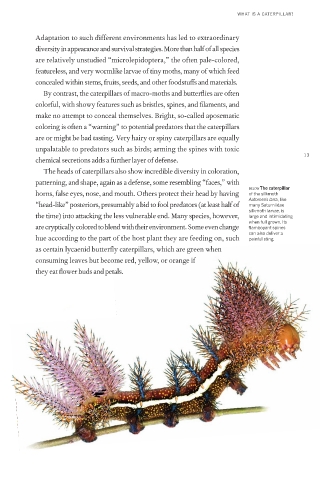
                                                                                BELOW The caterpillar
            horns, false eyes, nose, and mouth. Others protect their head by having   of the silkmoth
                                                                                Automeris larra, like
            “head-like” posteriors, presumably a bid to fool predators (at least half of   many Saturniidae
                                                                                silkmoth larvae, is
            the time) into attacking the less vulnerable end. Many species, however,   large and intimidating
                                                                                when full grown. Its
            are cryptically colored to blend with their environment. Some even change   fl amboyant spines
                                                                                can also deliver a
            hue according to the part of the host plant they are feeding on, such   painful sting.
            as certain lycaenid butterfly caterpillars, which are green when

            consuming leaves but become red, yellow, or orange if

            they eat flower buds and petals.

