


Page 16 - The Book of Caterpillars: A Life-Size Guide to Six Hundred Species From Around the World
P. 16
FROM EGGS


                           TO PUPATION

    14
    14


                           Like all eggs, butterfly and moth eggs are fragile and attractive to predators.

                           The relatively slow-moving larvae that hatch from them are also vulnerable
                           and, in order to survive their complex phases of development and reach
                           pupation, the final stage before adulthood, they must deploy a remarkable
          BELOW LEFT The   range of strategies that have evolved to meet the challenges of their habitats.
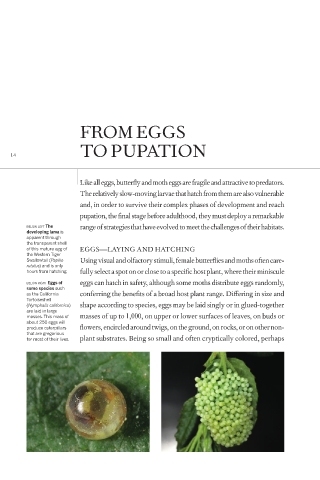
          developing larva is
          apparent through
          the transparent shell
          of this mature egg of   EGGS—LAYING AND HATCHING
          the Western Tiger
          Swallowtail (Papilio   Using visual and olfactory stimuli, female butterflies and moths often care-
          rutulus) and is only
          hours from hatching.  fully select a spot on or close to a specific host plant, where their miniscule
          BELOW RIGHT Eggs of   eggs can hatch in safety, although some moths distribute eggs randomly,
          some species such
          as the California   conferring the benefits of a broad host plant range. Differing in size and
          Tortoiseshell
          (Nymphalis californica)   shape according to species, eggs may be laid singly or in glued-together
          are laid in large
          masses. This mass of   masses of up to 1,000, on upper or lower surfaces of leaves, on buds or
          about 250 eggs will
          produce caterpillars   flowers, encircled around twigs, on the ground, on rocks, or on other non-
          that are gregarious
          for most of their lives.   plant substrates. Being so small and often cryptically colored, perhaps

