


Page 122 - The Book of Caterpillars: A Life-Size Guide to Six Hundred Species From Around the World
P. 122
BUTTERFLY CATERPILLARS

                                                     FAMILY  Pieridae
                                                   TRIBUTION
                                                 DISTRIBUTION
                                                 DISTRIBUTION  Africa, India, Sri Lanka, Myanmar, and parts of China
                                                 DIS
                                                    HABITAT
                                                    HABITAT T  Mountain meadows, grassland, gardens, and parks
                                                    HABIT
                                                       A
                                                    T PLANT
                                                  HOST PLANTS
                                                  HOST PLANTS S  Cassia spp. and Senna spp.
                                                  HOS

                                                      NO TE  Well-camouflaged green caterpillar that produces
                                                      NOTE
                                                      NOTE
                                                          a strong migrant
                                             CONSERVATION STATUS
                                             CONSERVATION STATUS
                                             CONSERV A TION S T A TUS  Not evaluated
            ADULT WINGSPAN
           2⅛–2⅝ in (54–66 mm)
           CATERPILLAR LENGTH
           Up to 1¾ in (45 mm)
                                                                           CATOPSILIA FLORELLA
                                                            AFRICAN MIGRANT
    120
                                                                                   (FABRICIUS, 1775)

                                            The female African Migrant lays her eggs singly on flower
                                            buds and young shoots of the host plants. The pale, elongated
                                            eggs are laid vertically on the surface so they look as if they
                                            are standing up. The young, green caterpillars emerge and
                                            feed on the buds, their color providing excellent camouflage.

                                            The older caterpillars then feed on the leaves, often defoliating
                                            the plant. Pupation occurs on stems or leaves. Like the larvae, the
                                            chrysalis is also green with a yellow line along the side, giving
                                            it the appearance of a leaf with a midrib.


                                            The adults, which are on the wing all year round, are powerful
                                            fliers, and they may migrate over long distances, hence
                                            the common name of the species. Those that breed in South
                                            Africa migrate in a northwest direction from summer to fall.

                                            Mass migrations have been reported in Tanzania, with butterflies
                                            flying north in November, then east in March, and finally
                                            returning south in May.


                     Actual size


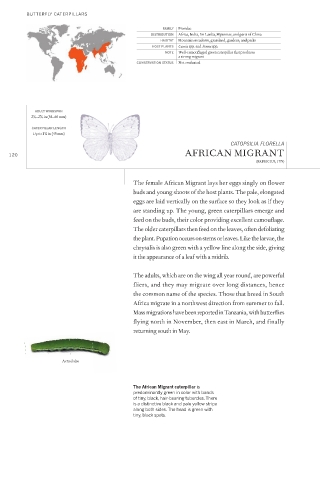
                                            The African Migrant caterpillar is
                                            predominantly green in color with bands
                                            of tiny, black, hair-bearing tubercles. There
                                            is a distinctive black and pale yellow stripe
                                            along both sides. The head is green with
                                            tiny, black spots.

