


Page 118 - The Book of Caterpillars: A Life-Size Guide to Six Hundred Species From Around the World
P. 118
BUTTERFLY CATERPILLARS

                                                     FAMILY  Hesperiidae
                                                 DISTRIBUTION  The Andes of Venezuela, Colombia, Ecuador, Peru, and Bolivia
                                                    HABITAT  Andean temperate and upper tropical forest edges and roadsides
                                                  HOST PLANTS  Various genera and species of grasses, including Cenchrus
                                                          tristachyus and Paspalum spp.

                                                      NOTE  Caterpillar that builds a well-camouflaged, tubelike shelter
                                             CONSERVATION STATUS  Not evaluated, but not likely to be endangered


            ADULT WINGSPAN
           1½–1¾ in (38–45 mm)
           CATERPILLAR LENGTH
           1–1³∕₁₆ in (25–30 mm)
                                                                              VETTIUS CORYNA
                                                    SILVER-PLATED SKIPPER
    116
                                                                                  (HEWITSON, 1866)


                                            Silver-plated Skipper caterpillars build and rest inside shelters
                                            created by making two cuts on opposite sides of a grass blade
                                            that almost meet at the midvein. The opposing leaf margins are
                                            drawn together with silk to form a shallow pocket or narrow
                      Actual size           tube. Lastly, a tiny cut is made near the base of the leaf midvein,
                                            causing the portion of the blade forming the shelter to sag
                                            downward into a vertical position. Older caterpillars have an
                                            eversible, pale, purple-red, ventral prothoracic “neck” gland.
                                            When disturbed, the caterpillar rears back onto its claspers and,
                                            with its head tipped back, everts the gland.
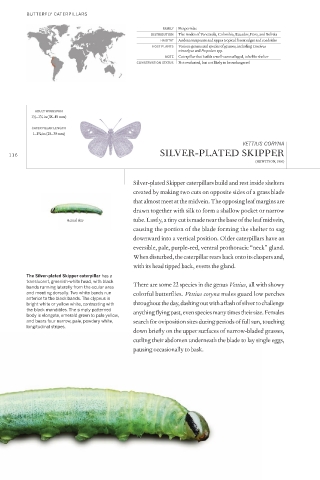
         The Silver-plated Skipper caterpillar has a
         translucent, greenish-white head, with black   There are some 22 species in the genus Vettius, all with showy
         bands running laterally from the ocular area
         and meeting dorsally. Two white bands run   colorful butterflies. Vettius coryna males guard low perches
         anterior to the black bands. The clypeus is

         bright white or yellow white, contrasting with   throughout the day, dashing out with a flash of silver to challenge
         the black mandibles. The simply patterned   anything flying past, even species many times their size. Females

         body is elongate, emerald green to pale yellow,
         and bears four narrow, pale, powdery white,   search for oviposition sites during periods of full sun, touching
         longitudinal stripes.
                                            down briefly on the upper surfaces of narrow-bladed grasses,

                                            curling their abdomen underneath the blade to lay single eggs,
                                            pausing occasionally to bask.

