


Page 120 - The Book of Caterpillars: A Life-Size Guide to Six Hundred Species From Around the World
P. 120
BUTTERFLY CATERPILLARS
FAMILY Pieridae
DISTRIBUTION Europe, North Africa, temperate Asia, Korea, and Japan
HABITAT Scrubby grasslands, roadsides, meadows, and woodland edges
HOST PLANTS Blackthorn (Prunus spinosus), Bird Cherry (Prunus padus),
hawthorn (Crataegus spp.), and Apple (Malus pumila)
NOTE Communal caterpillar that falls to the ground if disturbed
CONSERVATION STATUS Not evaluated, but usually common
ADULT WINGSPAN
2–2¾ in (50–70 mm)
CATERPILLAR LENGTH
1⁄–2 in (40–50 mm)
APORIA CRATAEGI
BLACK-VEINED WHITE
118
(LINNAEUS, 1758)
Black-veined White caterpillars hatch in July from yellow,
spindle-shaped eggs laid by the female butterfly in batches of
50 to 200 on the upper surfaces of host plant leaves. The young
larvae feed for a while, then enter hibernation as second or third
instars in September. During the early instars, caterpillars live
and feed communally but gradually become more independent
with age and are solitary in the final instar. Pupation occurs on
a twig or branch, with the chrysalis attached vertically by the
cremaster and a silken girdle.
The adult butterfl ies nectar at a variety of flowers, and males
often congregate on urine-tainted soil or animal dung. There
is a single generation annually, flying from May to August, and
drier habitats are preferred. There are about 30 related species
in the genus Aporia, most of which are limited to Southeast Asia.
Aporia crataegi used to occur in southern England but became
extinct in the 1920s.
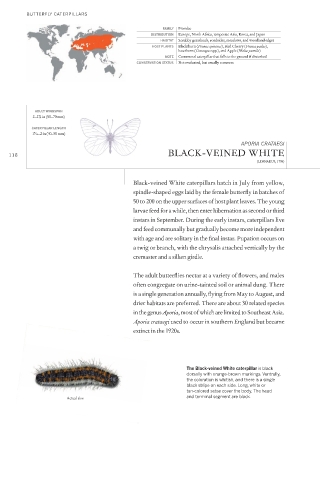
The Black-veined White caterpillar is black
dorsally with orange-brown markings. Ventrally,
the coloration is whitish, and there is a single
black stripe on each side. Long, white or
tan-colored setae cover the body. The head
Actual size and terminal segment are black.

