


Page 119 - The Book of Caterpillars: A Life-Size Guide to Six Hundred Species From Around the World
P. 119
BUTTERFLY CATERPILLARS

                      FAMILY  Pieridae
                  DISTRIBUTION  Western North America, from northwest Canada to Mexico
                     HABITAT  Riparian and open habitats, meadows, montane summits, slopes,
                           canyons, and shrub-steppe
                  HOST PLANTS  Rockcress (Arabis spp.), wintercress (Barbera spp.), and Tumble
                           Mustard (Sisymbrium altissimum)

                      NOTE  Cryptic caterpillar that becomes a dazzling spring butterfly
             CONSERVATION STATUS  Not evaluated, but considered secure within its range


                                                                                   ADULT WINGSPAN
                                                                                  1³∕₁₆–1³∕₈ in (30–35 mm)
                                                                                  CATERPILLAR LENGTH
                                                                                   ¾–1 in (20–25 mm)
            ANTHOCHARIS SARA
            SARA ORANGETIP                                                                       117

            LUCAS, 1852


            Sara Orangetip females lay their eggs singly, usually one per host
            plant; the eggs hatch in about four days. The caterpillars develop
            rapidly, taking only 16 to 20 days from egg hatch to pupation.
            They feed preferentially on flowers, buds, and seedpods, and

            then move on to leaves and stems, systematically consuming      Actual size

            the host plant as they move downward, finally eating the large
            basal leaves. The caterpillars often rest on seedpods or stems
            where their slender green bodies blend in well with the narrow,
            green plant parts.

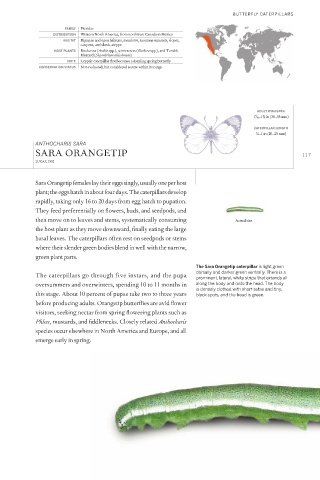
                                                                The Sara Orangetip caterpillar is light green
            The caterpillars go through five instars, and the pupa   dorsally and darker green ventrally. There is a
                                                                prominent, lateral, white stripe that extends all
            oversummers and overwinters, spending 10 to 11 months in   along the body and onto the head. The body
            this stage. About 10 percent of pupae take two to three years   is densely clothed with short setae and tiny,
                                                                black spots, and the head is green.

            before producing adults. Orangetip butterflies are avid flower

            visitors, seeking nectar from spring flowering plants such as


            Phlox, mustards, and fiddlenecks. Closely related Anthocharis
            species occur elsewhere in North America and Europe, and all
            emerge early in spring.

