


Page 121 - The Book of Caterpillars: A Life-Size Guide to Six Hundred Species From Around the World
P. 121
BUTTERFLY CATERPILLARS

                      FAMILY  Pieridae
                  DISTRIBUTION  Much of Australia, Papua New Guinea, Solomon Islands, Fiji,
                           and Indonesia (Java, West Papua)
                     HABITAT  Wherever food plants grow in tropical, subtropical, and
                           temperate areas, including the arid zone of central Australia
                  HOST PLANTS  Caper bushes (Capparis spp.) and Currant Bush
                           (Apophyllum anomalum)
                      NOTE  Caterpillar that can defoliate plants, including commercial
                           caper crops
             CONSERVATION STATUS  Not evaluated, but common


                                                                                   ADULT WINGSPAN
                                                                                    2⅛ in (55 mm)
                                                                                  CATERPILLAR LENGTH
                                                                                    1⁵∕₁₆ in (34 mm)
            BELENOIS JAVA
            CAPER WHITE                                                                          119

            (LINNAEUS, 1768)


            Caper White caterpillars hatch in clusters of up to 100 individuals
            and feed gregariously on the leaves of caper bushes, leaving
            only the midrib. The caterpillars complete their development in
            about three weeks. Although many larvae die, particularly as a

            result of disease and parasitism from tachinid flies, over a season
            complete defoliation of a large tree can occur, with hundreds
            of butterflies produced from a single tree. Other nearby trees


            may remain unaffected. The caterpillars can be minor pests in
            commercial caper crops.


            Caterpillars pupate on the leaves and stems of the food plants but
            might leave a defoliated plant to pupate. The pupa is attached to
            the plant via a silken central girdle and anal hooks into a silken
            pad. Adults migrate particularly during late spring, often flying

            hundreds of miles over a few days. The genus is large and mainly
            found in tropical Africa and Southwest Asia, with only this
            species occurring in Southeast Asia and Australia.


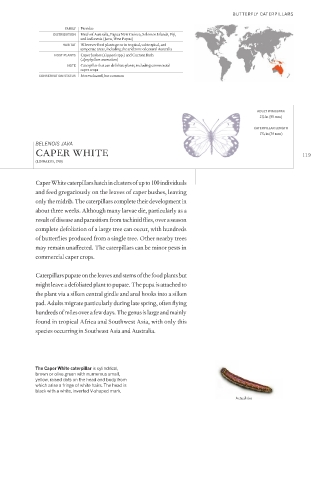
            The Caper White caterpillar is cylindrical,
            brown or olive green with numerous small,
            yellow, raised dots on the head and body from
            which arise a fringe of white hairs. The head is
            black with a white, inverted V-shaped mark.
                                                                            Actual size

