


Page 269 - The Book of Caterpillars: A Life-Size Guide to Six Hundred Species From Around the World
P. 269
BUTTERFLY CATERPILLARS

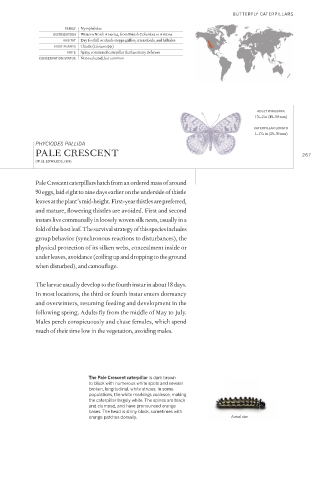
                      FAMILY  Nymphalidae
                  DISTRIBUTION  Western North America, from British Columbia to Arizona
                     HABITAT  Dry foothill or shrub-steppe gullies, streambeds, and hillsides
                  HOST PLANTS  Thistle (Cirsium spp.)
                      NOTE  Spiny, communal caterpillar that has many defenses
             CONSERVATION STATUS  Not evaluated, but common


                                                                                   ADULT WINGSPAN
                                                                                  1¾–2 in (45–50 mm)
                                                                                  CATERPILLAR LENGTH
                                                                                  1–1 ⁄   in (25–30 mm)
            PHYCIODES PALLIDA
            PALE CRESCENT                                                                        267

            (W. H. EDWARDS, 1864)


            Pale Crescent caterpillars hatch from an ordered mass of around
            90 eggs, laid eight to nine days earlier on the underside of thistle
            leaves at the plant’s mid-height. First-year thistles are preferred,
            and mature,  owering thistles are avoided. First and second

            instars live communally in loosely woven silk nests, usually in a
            fold of the host leaf. The survival strategy of this species includes
            group behavior (synchronous reactions to disturbances), the
            physical protection of its silken webs, concealment inside or
            under leaves, avoidance (coiling up and dropping to the ground
            when disturbed), and camou age.


            The larvae usually develop to the fourth instar in about 18 days.
            In most locations, the third or fourth instar enters dormancy
            and overwinters, resuming feeding and development in the
            following spring. Adults  y from the middle of May to July.

            Males perch conspicuously and chase females, which spend
            much of their time low in the vegetation, avoiding males.


                             The Pale Crescent caterpillar is dark brown
                             to black with numerous white spots and several
                             broken, longitudinal, white stripes. In some
                             populations, the white markings coalesce, making
                             the caterpillar largely white. The spines are black
                             and clumped, and have pronounced orange
                             bases. The head is shiny black, sometimes with
                             orange patches dorsally.                      Actual size

