


Page 267 - The Book of Caterpillars: A Life-Size Guide to Six Hundred Species From Around the World
P. 267
BUTTERFLY CATERPILLARS

                      FAMILY  Nymphalidae
                  DISTRIBUTION  Mainland New Guinea, and northeastern and eastern Australia
                     HABITAT  Coastal rain forest edges, especially along creeks, gullies,
                           and urban gardens
                  HOST PLANTS  Wide range, including species from Bombacaceae, Boraginaceae,
                           Fabaceae, Sterculiaceae, Tiliaceae, and Ulmaceae

                      NOTE  Caterpillar that creates dead-leaf camou age on its food plant
             CONSERVATION STATUS  Not evaluated, but locally common


                                                                                   ADULT WINGSPAN
                                                                                    2 ⁄   in (56 mm)
                                                                                  CATERPILLAR LENGTH

                                                                                    1⅓
 in (26 mm)

            PHAEDYMA SHEPHERDI
            WHITE-BANDED PLANE                                                                   265
            (MOORE, 1858)


            The White-banded Plane caterpillar hatches from pale yellow,
            pitted eggs laid on the shoots and young leaves of its food
            plant. The caterpillar cuts out small pieces of leaf and hangs
            them from the leaf edge on which it is feeding. These decaying

            leaf pieces provide an excellent camou age for the larva as it
            rests along the midrib of the leaf. Such dead-leaf fragments are
            a strong indicator of the presence of this species. The caterpillars
            develop slowly but are present throughout the year in the
            tropical areas of their range.

                                                                            Actual size
            Pupation occurs on the underside of a nearby uneaten leaf,
            the brownish pupa hanging head downward and attached by the

            cremaster to a silken pad. The adult butter ies have a distinctive

            gliding  ight. The males will defend territories in sunny patches
            in the rain forest, frequently returning to the same leaf to survey
            their own territory.

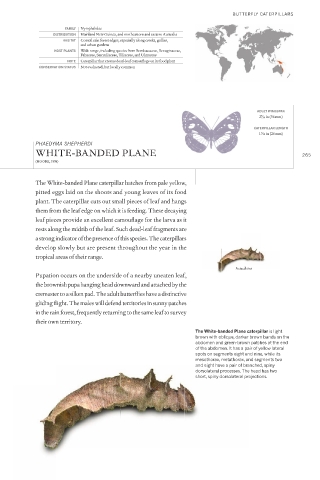
                                                               The White-banded Plane caterpillar is light
                                                               brown with oblique, darker brown bands on the
                                                               abdomen and green-brown patches at the end
                                                               of the abdomen. It has a pair of yellow lateral
                                                               spots on segments eight and nine, while its
                                                               mesothorax, metathorax, and segments two
                                                               and eight have a pair of branched, spiny
                                                               dorsolateral processes. The head has two
                                                               short, spiny dorsolateral projections.

