


Page 268 - The Book of Caterpillars: A Life-Size Guide to Six Hundred Species From Around the World
P. 268
BUTTERFLY CATERPILLARS

                                                     FAMILY  Nymphalidae
                                                 DISTRIBUTION  Areas of sub-Saharan Africa, and southern and Southeast Asia
                                                          to northern Australia
                                                    HABITAT  Tropical, riparian, monsoon forests from sea level to above
                                                          4,920 ft (1,500 m) elevation
                                                  HOST PLANTS  Flacourtia spp. and species from Acanthaceae, Compositae,
                                                          Primulaceae, Salicaceae, Rubiaceae, and Violaceae
                                                      NOTE  Most common and widespread caterpillar of its genus
                                             CONSERVATION STATUS  Not evaluated, but locally common and widely distributed


            ADULT WINGSPAN
           1  ⁄  –2⅛ in (46–55 mm)
           CATERPILLAR LENGTH
             1 in (25 mm)
                                                                         PHALANTA PHALANTHA
                                                            COMMON LEOPARD
    266
                                                                                    (DRURY, [1773])


                                            The Common Leopard caterpillar, also known as the Spotted
                                            Rustic, feeds openly on the foliage of its food plant, where it is
                                            very active and develops fast, taking about seven days to mature.
                                            The larvae are most abundant during the late dry season and at
                                            the end of the wet season following new growth of the plants on
                                            which they feed. When the caterpillar stops feeding, it wanders
                                            to the underside of a leaf where it spins a silk pad from which it
                                            hangs vertically to pupate. The pupa is a spectacular green with
                                            red and silver tubercles.


                                            Several generations of Phalanta phalantha are completed each
                                            season. The fast- ying adult is a sun-loving species, commonly

                                            seen  ying around  owering shrubs taking nectar, and at times


                                            exhibiting puddling behavior to imbibe salts from damp ground.
                                            The Common Leopard is the most common and widespread
                                            member of its genus, which contains six species.


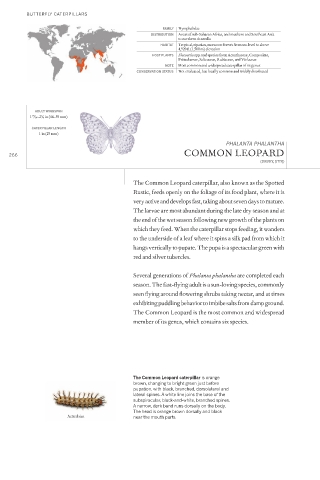
                                            The Common Leopard caterpillar is orange
                                            brown, changing to bright green just before
                                            pupation, with black, branched, dorsolateral and
                                            lateral spines. A white line joins the base of the
                                            subspiracular, black-and-white, branched spines.
                                            A narrow, dark band runs dorsally on the body.
                                            The head is orange brown dorsally and black
                       Actual size          near the mouth parts.

