


Page 299 - The Book of Caterpillars: A Life-Size Guide to Six Hundred Species From Around the World
P. 299
MOTH CATERPILLARS

                      FAMILY  Limacodidae
                  DISTRIBUTION  Eastern North America
                     HABITAT  Mixed deciduous forests
                  HOST PLANTS  Wide variety, both native and exotic, including Manila Palm
                           (Adonidia merrillii); Aster spp. and Helianthus spp. (Asteraceae);
                           Celtis spp. (Cannabaceae); and dogwood (Cornus spp.)
                      NOTE  Aposematically colored caterpillar that stings
             CONSERVATION STATUS  Not evaluated, but common


                                                                                   ADULT WINGSPAN
                                                                                  1–1  ⁄   in (25–43 mm)
                                                                                  CATERPILLAR LENGTH
                                                                                    ¾ in (20 mm)
            ACHARIA STIMULEA
            SADDLEBACK                                                                           297

            (CLEMENS, 1860)


            Saddleback moth caterpillars hatch from batches of 30 to 50 eggs,
            laid by the female moth on the upper side of host plant leaves.
            The caterpillars are truncated and sluglike, having prolegs with
            suction cups (instead of crochets, as in most caterpillars) on the
            ventral surface of the body. They produce a semi uid silk from

            their ventral pores as they move, which provides an adhesive      Actual size
            bond to smooth leaf surfaces. Young larvae feed gregariously.
            The second instars develop bright green saddle markings and
            urticating spines on the fleshy tubercles of the body, which

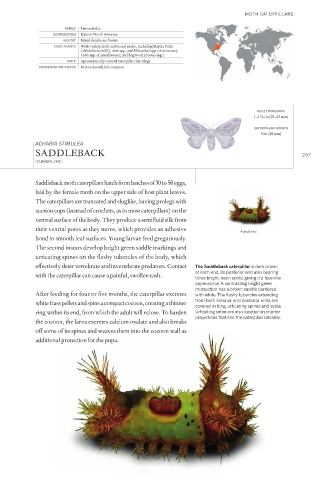
            e ectively deter vertebrate and invertebrate predators. Contact   The Saddleback caterpillar is dark brown
            with the caterpillar can cause a painful, swollen rash.   at each end, its posterior end also bearing
                                                               three bright, neon spots, giving it a face-like
                                                               appearance. A contrasting bright green
                                                               midsection has a brown saddle bordered
            After feeding for four or  ve months, the caterpillar excretes   with white. The   eshy tubercles extending

            white frass pellets and spins a compact cocoon, creating a thinner   from both anterior and posterior ends are
                                                               covered in long, urticating spines and setae.
            ring within its end, from which the adult will eclose. To harden   Urticating setae are also located on shorter
            the cocoon, the larva excretes calcium oxalate and also breaks   projections that line the caterpillar laterally.

            o  some of its spines and weaves them into the cocoon wall as
            additional protection for the pupa.

