


Page 298 - The Book of Caterpillars: A Life-Size Guide to Six Hundred Species From Around the World
P. 298
MOTH CATERPILLARS

                                                     FAMILY  Limacodidae
                                                 DISTRIBUTION  From Mexico to Peru
                                                    HABITAT  Medium to high elevation rain forests, at 650–2,625 ft
                                                          (200–800 m) elevation
                                                  HOST PLANTS  Trees, including South American Holly (Ilex paraguariensis),
                                                          oil palm (Elaeis spp.), Avocado (Persea americana), plum
                                                          (Prunus spp.), and Citrus spp.
                                                      NOTE  Spiny caterpillar that has stinging hairs
                                             CONSERVATION STATUS  Not evaluated, but likely secure


            ADULT WINGSPAN
           1 ⁄  –2⅜ in (40–60 mm)
           CATERPILLAR LENGTH
             1 in (25 mm)
                                                                               ACHARIA NESEA
                                                            STOLL’S CUP MOTH
    296
                                                                                     (STOLL, 1780)


                                            Caterpillars of the Limacodidae family are extraordinarily
                                            spiny, and the Stoll’s Cup Moth caterpillar is no exception.
                                            It hatches among eggs that are dorsoventrally  at and thin, and


                                            quite transparent, and bears  eshy horns carrying groups of

                                            stinging hairs. These hairs can break o  and cause serious pain
                                            to anyone who touches them. Like all limacodids, the Stoll’s
                       Actual size
                                            Cup Moth caterpillar has suckers instead of prolegs, which help
                                            it attach securely to substrates.


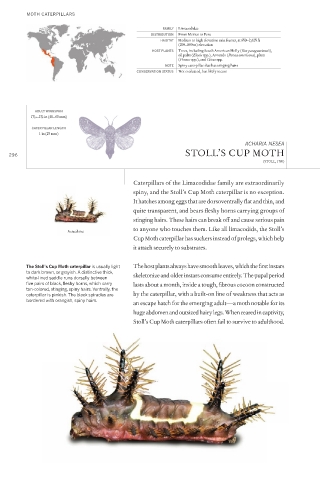
         The Stoll’s Cup Moth caterpillar is usually light   The host plants always have smooth leaves, which the  rst instars
         to dark brown, or grayish. A distinctive thick,   skeletonize and older instars consume entirely. The pupal period
         white-lined saddle runs dorsally between

           ve pairs of black,   eshy horns, which carry   lasts about a month, inside a tough,  brous cocoon constructed
         tan-colored, stinging, spiny hairs. Ventrally, the
         caterpillar is pinkish. The black spiracles are   by the caterpillar, with a built-on line of weakness that acts as
         bordered with orangish, spiny hairs.  an escape hatch for the emerging adult—a moth notable for its
                                            huge abdomen and outsized hairy legs. When reared in captivity,
                                            Stoll’s Cup Moth caterpillars often fail to survive to adulthood.

