


Page 301 - The Book of Caterpillars: A Life-Size Guide to Six Hundred Species From Around the World
P. 301
MOTH CATERPILLARS

                      FAMILY  Limacodidae
                  DISTRIBUTION  From southern United Kingdom, northern Spain, and southern
                           Scandinavia east to Asia Minor and the Caucasus
                     HABITAT  Forests, smaller woodlands, and parklands
                  HOST PLANTS  Oak (Quercus spp.), hornbeam (Carpinus spp.), and European
                           Beech (Fagus sylvatica)
                      NOTE  Caterpillar whose species name derives from the Limax
                           slug genus
             CONSERVATION STATUS  Not evaluated, but widespread throughout most of its range


                                                                                   ADULT WINGSPAN

⁄  –1¼ in (24–32 mm)
                                                                                  CATERPILLAR LENGTH
                                                                                  ½–⅝ in (13–16 mm)
            APODA LIMACODES
            FESTOON                                                                              299

            (HUFNAGEL, 1766)


            The Festoon caterpillar lives among tree foliage on which it
            feeds and can be found from July to October. The flattened
            oval, yellowish eggs are laid singly or in small groups on the
            underside of a leaf and hatch after two weeks. The caterpillar


            is well camou aged and hard to  nd, often living high in the
            tree and clinging on very tightly. Pupation occurs in a tough,
            brownish oval cocoon (with a circular escape hatch), spun on the
            upper side of a leaf, which falls to the ground in fall.


            The rusty brown, rather broad-winged adults  y in June and
            July. Limacodids are mainly tropical moths. Their caterpillars
            are highly varied, and some are remarkable, brightly colored
            creatures with poisonous, protective, stinging barbs and strange
            cactus-like growths and spines, or star sh-like “arms.” Other

            limacodid larvae are smooth and, like the Festoon, may resemble

            those of lycaenid butter ies. However, lycaenid caterpillars are

            covered in  ne, very short hairs and the head extends out of the
            hood when feeding.


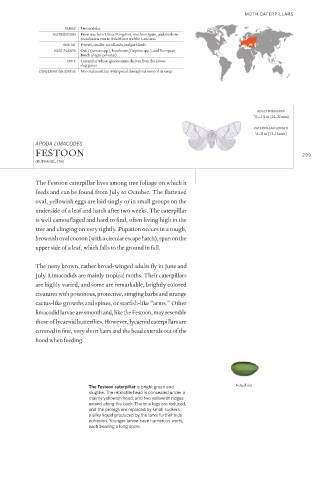
                             The Festoon caterpillar is bright green and    Actual size
                             sluglike. The retractile head is concealed under a
                             mainly yellowish hood, and two yellowish ridges
                             extend along the back. The true legs are reduced,
                             and the prolegs are replaced by small suckers;
                             a silky liquid produced by the larva further aids
                             adhesion. Younger larvae have numerous warts,
                             each bearing a long spine.

