


Page 49 - The Book of Caterpillars: A Life-Size Guide to Six Hundred Species From Around the World
P. 49
BUTTERFLY CATERPILLARS
FAMILY Papilionidae
TRIBUTION
DISTRIBUTION
DISTRIBUTION Eastern Australia
DIS
HABITAT
HABITAT T Eucalypt open forests and suburban gardens
HABIT
A
HOST PLANTS
HOST PLANTS S Mainly Citrus spp., but also other genera of Rutaceae
HOS
T PLANT
NOTE Caterpillars that can cause minor damage to Citrus trees
TE
NOTE
NO
TUS
A
T
A
TION S
CONSERVATION STATUS Not evaluated, but common
CONSERV
CONSERVATION STATUS
ADULT WINGSPAN
2⅝–2⁄ in (67–72 mm)
CATERPILLAR LENGTH
1½ in (38 mm)
PAPILIO ANACTUS
DAINTY SWALLOWTAIL 47
MACLEAY, 1826
The Dainty Swallowtail caterpillar eggs are laid singly on the
edge of young leaves and shoots. They hatch in a few days, and
the caterpillars consume their eggshell. The larvae feed openly
during the day and in the early instars are camouflaged in a
“bird dropping” pattern. All instars have a fleshy osmeterium
that is everted when the larva becomes alarmed by potential
threats. The osmeterium produces a Citrus-like, odoriferous
secretion. In the northern half of its range, the species breeds
throughout the year.
Pupation takes place on twigs of the host tree but often well away
from where the caterpillars have been feeding. Pupae produced
in the fall in southern areas overwinter and do not emerge until at
least the following spring. The species has expanded its normal
range by breeding in urban gardens that have planted Citrus.
Male butterflies patrol in open areas up to 6 ft (1.8 m) above the
ground and can also be found on the top of hills.
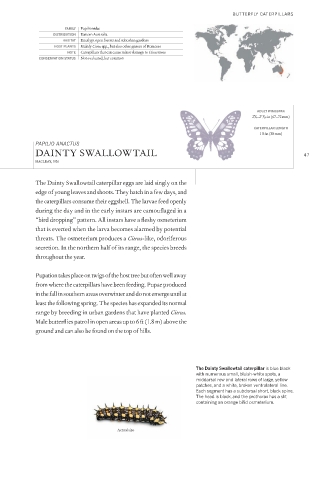
The Dainty Swallowtail caterpillar is blue black
with numerous small, bluish-white spots, a
middorsal row and lateral rows of large, yellow
patches, and a white, broken ventrolateral line.
Each segment has a subdorsal short, black spine.
The head is black, and the prothorax has a slit
containing an orange bi d osmeterium.
Actual size

