


Page 50 - The Book of Caterpillars: A Life-Size Guide to Six Hundred Species From Around the World
P. 50
BUTTERFLY CATERPILLARS

                                                     FAMILY  Papilionidae
                                                 DISTRIBUTION  From Mexico south to Argentina, including the Caribbean,
                                                          with a small population in southern Florida
                                                    HABITAT  Open areas and secondary growth
                                                  HOST PLANTS  Zanthoxylum spp. and Citrus spp.
                                                      NOTE  Caterpillars that resemble bird droppings in early instars
                                             CONSERVATION STATUS  Not evaluated, but locally common


            ADULT WINGSPAN
          5¼–5½ in (134–140 mm)
           CATERPILLAR LENGTH
            3–4 in (76–100 mm)
                                                                           PAPILIO ANDROGEUS
                                             ANDROGEUS SWALLOWTAIL
    48
                                                                                    CRAMER, [1775]


                                            Androgeus Swallowtail caterpillars hatch from green eggs laid
                                            singly on leaf tips of the host plant and are initially orange brown
                                            with a shiny skin. Typical of swallowtails, they resemble bird
                                            droppings, with characteristic streaks of blue throughout the
                                            brown areas, and feed openly on leaf upper surfaces. Within
                                            a month, the larvae reach full size and spend most of their
                                            non-feeding time on twigs, where they are well camouflaged.

                                            When fully developed, the caterpillars pupate on twigs. In parts

                                            of the range, pupae overwinter, and the adults fly in the spring.
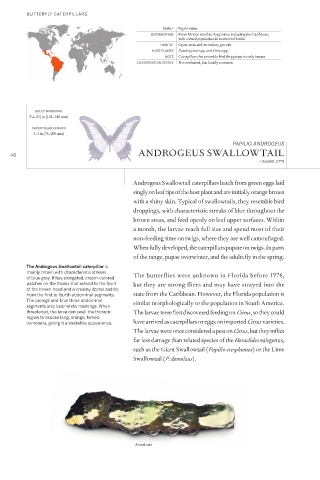
         The Androgeus Swallowtail caterpillar is
         mainly brown with characteristic streaks   The butterflies were unknown in Florida before 1976,
         of blue gray. It has elongated, cream-colored
         patches on the thorax that extend to the front   but they are strong fliers and may have strayed into the
         of the brown head and a creamy dorsal saddle
         from the   rst to fourth abdominal segments.   state from the Caribbean. However, the Florida population is
         The prolegs and   nal three abdominal   similar morphologically to the population in South America.
         segments also bear white markings. When

         threatened, the larva can swell the thoracic   The larvae were first discovered feeding on Citrus, so they could
         region to expose long, orange, forked
         osmeteria, giving it a snakelike appearance.  have arrived as caterpillars or eggs on imported Citrus varieties.
                                            The larvae were once considered a pest on Citrus, but they inflict

                                            far less damage than related species of the Heraclides subgenus,
                                            such as the Giant Swallowtail (Papilio cresphontes) or the Lime
                                            Swallowtail (P. demoleus).


                                            Actual size

