


Page 51 - The Book of Caterpillars: A Life-Size Guide to Six Hundred Species From Around the World
P. 51
BUTTERFLY CATERPILLARS

                      FAMILY  Papilionidae
                  DISTRIBUTION  Florida, the Bahamas, Hispaniola, and Cuba
                     HABITAT  Tropical hardwood hammock
                  HOST PLANTS  Torchwood (Amyris elemifera); in captivity has also fed on
                           Wild Lime (Zanthoxylum fagara)
                      NOTE  Caterpillar that exposes forked white osmeteria when disturbed
             CONSERVATION STATUS  Not evaluated, but listed as federally endangered in the
                           United States (subspecies ponceanus) and uncommon elsewhere
                           in its range


                                                                                   ADULT WINGSPAN
                                                                                  3⅜–5 in (86–130 mm)
                                                                                  CATERPILLAR LENGTH
                                                                                  2⅜–3⅛ in (60–80 mm)
            PAPILIO ARISTODEMUS
            SCHAUS’ SWALLOWTAIL                                                                   49

            ESPER, 1794


            Early instar Schaus’ Swallowtail larvae, like those of other
            members of their genus, resemble bird or lizard droppings—
            dark, with white uric acid splashes toward one end. Thus
            camouflaged, young caterpillars rest openly on the upper
            surface of leaves, where bird droppings land. In later instars,
            when too large to resemble droppings, they tend to feed at night
            and rest on twigs during the day. Approaching maturity, larvae
            develop white bands toward the middle of the body, which
            probably serve to break up their outline and reduce the chances
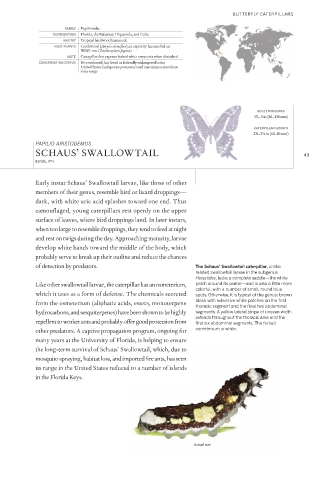
            of detection by predators.                         The Schaus’ Swallowtail caterpillar, unlike
                                                               related swallowtail larvae in the subgenus
                                                               Heraclides, lacks a complete saddle—the white
            Like other swallowtail larvae, the caterpillar has an osmeterium,   patch around its center—and is also a little more
            which it uses as a form of defense. The chemicals secreted   colorful, with a number of small, round blue
                                                               spots. Otherwise, it is typical of the genus: brown
            from the osmeterium (aliphatic acids, esters, monoterpene   black with extensive white patches on the   rst
                                                               thoracic segment and the   nal two abdominal
            hydrocarbons, and sesquiterpenes) have been shown to be highly   segments. A yellow lateral stripe of uneven width
            repellent to worker ants and probably offer good protection from   extends throughout the thoracic area and the

                                                                 rst six abdominal segments. The forked
            other predators. A captive propagation program, ongoing for   osmeterium is white.
            many years at the University of Florida, is helping to ensure
            the long-term survival of Schaus’ Swallowtail, which, due to
            mosquito spraying, habitat loss, and imported fire ants, has seen

            its range in the United States reduced to a number of islands
            in the Florida Keys.


                                                               Actual size

