


Page 491 - The Book of Caterpillars: A Life-Size Guide to Six Hundred Species From Around the World
P. 491
MOTH CATERPILLARS

                      FAMILY  Geometridae
                           Across Europe to western Siberia
                           Across Europe to western Siberia
                  DISTRIBUTION
                  DISTRIBUTION
                  DIS TRIBUTION  Acr oss Eur ope to w ester n Sib eria
                                     s
                                  , park
                           Forests, woods, parks, and gardens
                              , w
                             ts
                                oods
                                           ns
                                      nd garde
                           ores
                                     , a
                     HABITAT
                     HABIT A T  F Forests, woods, parks, and gardens
                     HABITAT
                                 uous tree
                                            , in
                                          ubs
                                             c
                                                  birch (
                                              luding
                                          r
                           Various deciduous trees and shrubs, including birch (Betula spp.),
                           V
                             us decid
                                      s and sh
                            ario
                  HOS T PLANT S  Various deciduous trees and shrubs, including birch (
                  HOST PLANTS
                  HOST PLANTS
                              uck
                              uck
                              uck
                              uck
                                    e
                                     r
                                     r
                              uck
                                   ic
                                    e
                                le (
                                le (
                                le (
                                  L
                                le (
                                  on
                                   ic
                                  on
                                le (
                                  L
                           honeys
                           honeys
                           honeysuckle (Lonicera spp.), oak (Quercus spp.), Prunus spp., and
                           honeys
                           honeysuckle (Lonicera a a
                           honeys
                           honeys
                                  spp
                                ix
                                ix
                                al
                               S
                                al
                                al
                                ix
                                al
                                   .
                                   .
                                  spp
                                ix
                                ix
                                al
                               S
                             w (
                           willow (Salix spp.)  ) )
                            lo
                           willow (Salix spp.)
                           wil
                               S
                               S
                               S
                                                   em
                                                     ent
                                                  v
                                              ping mo
                                         a c
                                     that has
                                          las
                                           sic loo
                                 r
                                  pillar
                           T
                           Twiglike caterpillar that has a classic looping movement
                               e cate
                            wig
                             lik
                        TE
                      NOTE
                      NO
                      NOTE  Twiglike caterpillar that has a classic looping movement
                           Not evaluated, but a common species
                           Not evaluated, but a common species
             CONSERVATION STATUS  Not e valuated,  but a co mmon spe cies
                  A
                   TION S
             CONSERV
                       TUS
                       A
             CONSERVATION STATUS
                      T
                                                                                   ADULT WINGSPAN

                                                                                  1⅜–1⅝ in (35–41 mm)

                                                                                  CATERPILLAR LENGTH
                                                                                  1 ⁄  –1¾ in (40–45 mm)
            CROCALLIS ELINGUARIA
            SCALLOPED OAK                                                                        489
            (LINNAEUS, 1758)
            Scalloped Oak caterpillars hatch from cube-shaped eggs laid in
            batches. Having found a suitable leaf, the adult female lays the
            eggs in a row so that they are touching, lined up along the leaf
            edge. The eggs overwinter and hatch the following spring; the
            caterpillars are then seen from April to July, feeding on a variety   The Scalloped Oak caterpillar has an elongated,
            of deciduous trees and shrubs. They eat mostly leaves but are   slender body. The colors are variable, ranging
                                                                from gray to dark brown. The pattern of patches,
            known to be omnivorous as they will attack and eat smaller   diamonds, stripes, and longitudinal lines,
            caterpillars of the same species. The pupa is red brown.  together with small tubercles, creates the perfect
                                                                impression of a twig. The head is brown, and
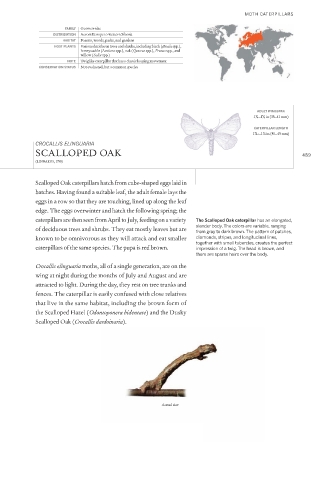
                                                                there are sparse hairs over the body.
            Crocallis elinguaria moths, all of a single generation, are on the
            wing at night during the months of July and August and are
            attracted to light. During the day, they rest on tree trunks and
            fences. The caterpillar is easily confused with close relatives
            that live in the same habitat, including the brown form of
            the Scalloped Hazel (Odontoponera bidentate) and the Dusky
            Scalloped Oak (Crocallis dardoinaria).
                                                     Actual size

