


Page 492 - The Book of Caterpillars: A Life-Size Guide to Six Hundred Species From Around the World
P. 492
MOTH CATERPILLARS

                                                     FAMILY  Geometridae
                                                   TRIBUTION
                                                 DISTRIBUTION  Parts of Southeast Asia and northern Australia
                                                 DIS
                                                 DISTRIBUTION
                                                    HABIT
                                                       A
                                                    HABITAT T  Tropical rain forests
                                                    HABITAT
                                                  HOST PLANTS S  Carallia brachiata
                                                    T PLANT
                                                  HOST PLANTS
                                                  HOS
                                                      NOTE
                                                      NO
                                                      NOTE  Caterpillar that, when resting, can resemble a catkin
                                                       TE
                                                     T
                                             CONSERV
                                                 A
                                                  TION S
                                                      TUS
                                                      A
                                             CONSERVATION STATUS
                                             CONSERVATION STATUS  Not evaluated
            ADULT WINGSPAN
           3–3⅛ in (75–80 mm)
           CATERPILLAR LENGTH
             2⅜ in (60 mm)
                                                                         DYSPHANIA FENESTRATA
                                                        FOUR O’CLOCK MOTH
    490
                                                                                   SWAINSON, 1833
                                            The Four O’Clock Moth caterpillar takes on an unusual position
                                            while resting on the food plant. It has a short thorax, so the legs
                                            are tight together, and a long, slender abdomen with two pairs
                                            of claspers at the rear, which the caterpillar uses to suspend its
                                            body from the leaf and hold it steady, so that it looks like a catkin.
                                            The larvae feed primarily on the leaves of Carallia brachiata,
                                            a small rain forest tree, and in groups may completely defoliate
                                            the tree. The mature caterpillar pupates in a fold of a leaf, which
                                            it holds in place with silk threads.


                                            The brightly colored, day- ying moth adult gets its name from
                                            the time that it tends to appear, later afternoon, hence “Four
                                            O’Clock.” It is also known as the Peacock Jewel. The caterpillar
                                            is equally brightly colored, a clear warning that it is distasteful
                                            and should be avoided by predators.


                                             Actual size


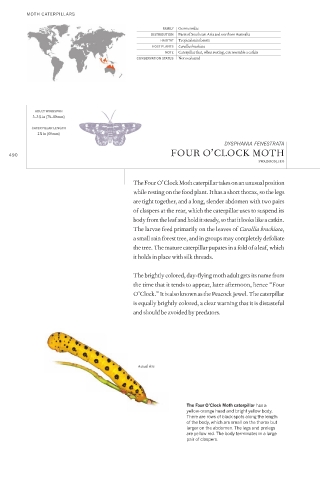
                                                             The Four O’Clock Moth caterpillar has a
                                                             yellow-orange head and bright yellow body.
                                                             There are rows of black spots along the length
                                                             of the body, which are small on the thorax but
                                                             larger on the abdomen. The legs and prolegs
                                                             are yellow red. The body terminates in a large
                                                             pair of claspers.

