


Page 495 - The Book of Caterpillars: A Life-Size Guide to Six Hundred Species From Around the World
P. 495
MOTH CATERPILLARS

                      FAMILY  Geometridae
                  DISTRIBUTION  Northwest Africa, across Europe, through the Caucasus to
                           northern Iran, and across Russia to northeast China
                     HABITAT  Woodlands, orchards, grasslands, parks, and gardens
                  HOST PLANTS  Various deciduous trees and shrubs, including Apple (Malus
                           pumila), birch (Betula spp.), oak (Quercus spp.), Prunus spp.,
                           and willow (Salix spp.)
                      NOTE  Defoliating caterpillar that is considered a pest species
             CONSERVATION STATUS  Not evaluated, but very common


                                                                                   ADULT WINGSPAN
                                                                                  1 ⁄  –1 ⁄   in (30–40 mm)
                                                                                  CATERPILLAR LENGTH
                                                                                  1 ⁄  –1⅜ in (30–35 mm)


            ERANNIS DEFOLIARIA
            MOTTLED UMBER                                                                        493
            (CLERCK, 1759)


            Mottled Umber caterpillars hatch from chains of pale brown,
            oval eggs deposited on the bark of the host plant. Once laid,
            the eggs overwinter and then hatch the following spring. The
            larvae are gregarious, staying in a group and spinning leaves
            together to create a shelter, in which they remain hidden from
            predators, dropping to the ground if disturbed. Pupation takes
            place underground in a cocoon.


            The female Mottled Umber moth is wingless, has a spiderlike
            appearance, and remains on the host tree. The nocturnal male
            moths, all part of a single generation, are on the wing from
            October to December and are attracted to light. They rest on
            trees, fences, and walls during the day. The caterpillars damage
            the  ower buds and leaves of the host plant, and infestations

            of larvae can defoliate entire trees in orchards and woodlands.
            As a result, the species is considered a pest.


                                                                                     Actual size


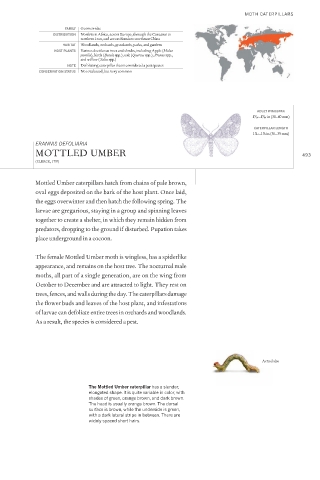
                             The Mottled Umber caterpillar has a slender,
                             elongated shape. It is quite variable in color, with
                             shades of green, orange brown, and dark brown.
                             The head is usually orange brown. The dorsal
                             surface is brown, while the underside is green,
                             with a dark lateral stripe in between. There are
                             widely spaced short hairs.

