


Page 489 - The Book of Caterpillars: A Life-Size Guide to Six Hundred Species From Around the World
P. 489
MOTH CATERPILLARS

                      FAMILY  Geometridae
                  DISTRIBUTION  North America, Europe, and across Asia
                     HABITAT  Deciduous and mixed woodlands
                  HOST PLANTS  Various trees, including Alder (Alnus glutinosa), birch (Betula
                           spp.), elm (Ulmus spp.), maple (Acer spp.), walnut (Juglans spp.),
                           and willow (Salix spp.)

                      NOTE  Superbly camou aged caterpillar that is often overlooked
             CONSERVATION STATUS  Not evaluated


                                                                                   ADULT WINGSPAN
                                                                                  1⅜–2⅜ in (35–60 mm)


                                                                                  CATERPILLAR LENGTH
                                                                                  2⅜–2¾ in (60–70 mm)
            BISTON BETULARIA
            PEPPERED MOTH                                                                        487

            LINNAEUS, 1758


            The female Peppered Moth lays up to 600 yellow eggs, singly,
            either in bark crevices or on leaves. The caterpillar is a twig
            mimic; the slender shape and colors of green and brown provide

            it with excellent camou age when at rest during the day. The
            caterpillars move to the ground to pupate, and they overwinter
            within a cocoon in the soil or in leaf litter. The adults emerge in
            late spring and early summer. There is usually one generation,
            with the adults on the wing from April to September.


            This is a polymorphic species that has been the subject of
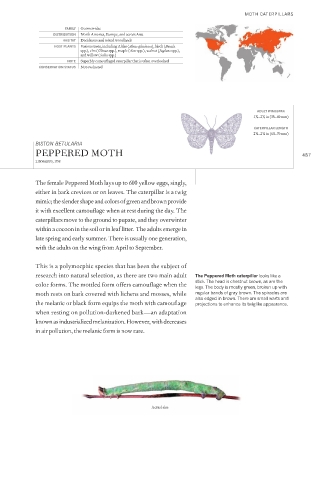
            research into natural selection, as there are two main adult   The Peppered Moth caterpillar looks like a
            color forms. The mottled form offers camouflage when the   stick. The head is chestnut brown, as are the
                                                               legs. The body is mostly green, broken up with
            moth rests on bark covered with lichens and mosses, while   regular bands of gray brown. The spiracles are
            the melanic or black form equips the moth with camouflage   also edged in brown. There are small warts and
                                                               projections to enhance its twiglike appearance.
            when resting on pollution-darkened bark—an adaptation
            known as industrialized melanization. However, with decreases
            in air pollution, the melanic form is now rare.


                                                 Actual size

