


Page 487 - The Book of Caterpillars: A Life-Size Guide to Six Hundred Species From Around the World
P. 487
MOTH CATERPILLARS

                      FAMILY  Geometridae
                  DISTRIBUTION  North Africa, the Middle East, southern Europe, the Balkans,
                           and east to Kazakhstan
                     HABITAT  Meadows, dry grasslands, steppe, embankments, and olive groves
                  HOST PLANTS  Various herbaceous species, especially members of Asteraceae,
                           such as carrot (Daucus spp.) and ragwort (Senecio spp.)

                      NOTE  Odd-looking caterpillar camou aged to resemble a spiky fruit
             CONSERVATION STATUS  Not evaluated


                                                                                   ADULT WINGSPAN
                                                                                  1 ⁄  –1⅝ in (30–42 mm)
                                                                                  CATERPILLAR LENGTH
            APOCHIMA FLABELLARIA                                                  1 ⁄  –2 in (40–50 mm)
            MEDITERRANEAN
            BRINDLED BEAUTY                                                                      485

            (HEEGER, 1838)


            The caterpillars of the Mediterranean Brindled Beauty moth
            hatch from eggs laid on the stems of the host plant. The larvae
            are seen from April to June feeding on the young leaves and
            flowerheads, their cryptic coloration and spines giving the
            impression of a spiky fruit. When disturbed, they roll into a
            ball, the spikes deterring predators, such as birds. The mature
            caterpillars fall to the ground and spin a cocoon under rocks or
            in the soil, where they pupate and overwinter. The pupa is red
            brown in color.


            The night- ying moths are on the wing from February to April,
            and there is a single generation. They have a distinctive resting
            position, with the wings folded, hence their species name, which
            means “small fan.” The forewings are folded and held out in a
            V shape, while the hindwings are held against the body. In many
            texts the species is referred to as Zamacra  abellaria.


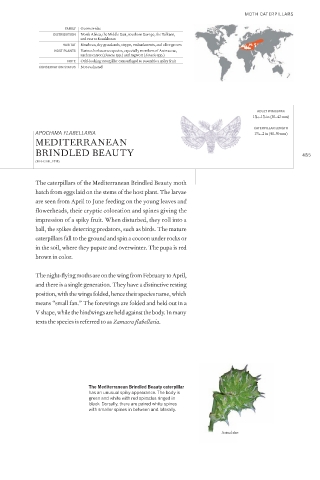
                             The Mediterranean Brindled Beauty caterpillar
                             has an unusual spiky appearance. The body is
                             green and white with red spiracles ringed in
                             black. Dorsally, there are paired white spines
                             with smaller spines in between and laterally.


                                                                        Actual size

