


Page 488 - The Book of Caterpillars: A Life-Size Guide to Six Hundred Species From Around the World
P. 488
MOTH CATERPILLARS

                                                     FAMILY  Geometridae
                                                 DISTRIBUTION
                                                 DIS TRIBUTION  Europe and across northern Asia to Korea and Japan
                                                 DISTRIBUTION
                                                    HABIT
                                                    HABITAT T  Forests, woodlands, parks, and heathlands
                                                    HABITAT
                                                       A
                                                  HOST PLANTS
                                                    T PLANT
                                                  HOST PLANTS S  Birch (Betula spp.)
                                                  HOS
                                                      NOTE
                                                      NOTE  Caterpillar that is active at night and rarely observed
                                                       TE
                                                      NO
                                                     T
                                             CONSERV
                                             CONSERVATION STATUS
                                                  TION S
                                                      A
                                                      TUS
                                                 A
                                             CONSERVATION STATUS  Not evaluated, but locally endangered
            ADULT WINGSPAN
           1 ⁄  –1 ⁄   in (30–40 mm)
           CATERPILLAR LENGTH
             1 in (25 mm)
                                                                        ARCHIEARIS PARTHENIAS
                                                       ORANGE UNDERWING
    486
                                                                                   (LINNAEUS, 1761)
                                            Orange Underwing caterpillars hatch from eggs laid in small
                                            groups on birch twigs, usually in the angle between a twig and
                                            a bud. The larvae hatch at night, which is also the time they
                                            feed—initially on catkins before moving on to the leaves.
                                            During the day, the caterpillars shelter in a silk web or leaf tent.
                     Actual size
                                            They move to the ground to pupate in leaf litter or under moss
                                            and overwinter there.


                                            Archiearis parthenias adults, produced within a single generation,
                                            are active on bright, sunny spring days, when they can be seen
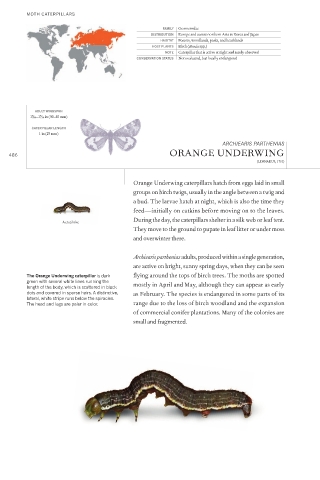
          The Orange Underwing caterpillar is dark   flying around the tops of birch trees. The moths are spotted
          green with several white lines running the   mostly in April and May, although they can appear as early
          length of the body, which is scattered in black
          dots and covered in sparse hairs. A distinctive,   as February. The species is endangered in some parts of its
          lateral, white stripe runs below the spiracles.
          The head and legs are paler in color.  range due to the loss of birch woodland and the expansion
                                            of commercial conifer plantations. Many of the colonies are
                                            small and fragmented.

