


Page 493 - The Book of Caterpillars: A Life-Size Guide to Six Hundred Species From Around the World
P. 493
MOTH CATERPILLARS

                      FAMILY  Geometridae
                  DISTRIBUTION  Europe and across northern Asia to Siberia
                     HABITAT  Woodlands, parks, and gardens
                  HOST PLANTS  Range of deciduous trees, including birch (Betula spp.),
                           oak (Quercus spp.), and elm (Ulmus spp.)
                      NOTE  Twiglike caterpillar that is found among leaves of deciduous trees
             CONSERVATION STATUS  Not evaluated, but scarce in parts of its range


                                                                                   ADULT WINGSPAN
                                                                                  1 ⁄  –2 in (40–50 mm)
                                                                                  CATERPILLAR LENGTH
                                                                                    2 in (50 mm)
            ENNOMOS AUTUMNARIA
            LARGE THORN                                                                          491

            (WERNEBERG, 1859)


            The female Large Thorn lays her eggs on the leaves of deciduous
            trees in fall, and the eggs overwinter and hatch in spring. The
            caterpillars remain in the canopy, feeding at night on the leaves
            of a wide variety of deciduous trees. During the day, the
            larvae stay motionless on the branches, relying on their

            camou age to avoid predation. Their development to the  nal

            instar often takes several months. They then pupate in a cocoon
            spun between leaves. The moths eclose up to six weeks later.

            Like all members of the family Geometridae, the caterpillars
            have a looping movement, giving them the generic name
            “loopers.” In August, the caterpillar drops to the ground,
            where it pupates in a cocoon in the leaf litter or under moss.
            The adult emerges a few weeks later. Unusually, the moth is
            a fall-flying species with the adults on the wing during
            September and October. The Large Thorn is becoming scarce
            in some countries, such as the United Kingdom, likely because
            of urbanization.


                                                   Actual size


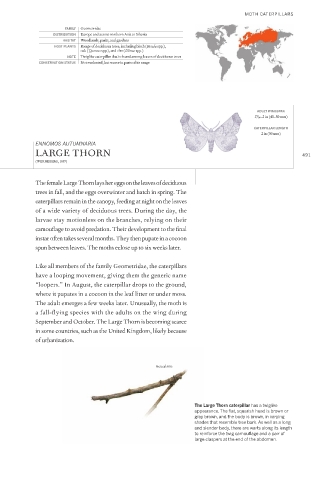
                                                               The Large Thorn caterpillar has a twiglike
                                                               appearance. The   at, squarish head is brown or
                                                               gray brown, and the body is brown, in varying
                                                               shades that resemble tree bark. As well as a long
                                                               and slender body, there are warts along its length
                                                               to reinforce the twig camou  age and a pair of
                                                               large claspers at the end of the abdomen.

