


Page 494 - The Book of Caterpillars: A Life-Size Guide to Six Hundred Species From Around the World
P. 494
MOTH CATERPILLARS

                                                     FAMILY  Geometridae
                                                 DISTRIBUTION  From southern Canada south to Georgia (and possibly to the
                                                          Florida panhandle) in the eastern United States and to northern
                                                          California in the west
                                                    HABITAT  Deciduous and mixed forests
                                                  HOST PLANTS  Alder (Alnus spp.), ash (Fraxinus spp.), birch (Betula spp.),
                                                          acer (Acer spp.), oak (Quercus spp.), and poplar (Populus spp.)
                                                      NOTE  Sticklike caterpillar that blends in with its host plant twigs
                                             CONSERVATION STATUS  Not evaluated, but common


            ADULT WINGSPAN
           1  ⁄  –2⅜ in (43–60 mm)
           CATERPILLAR LENGTH
           2¾–3⅛ in (70–80 mm)
                                                                           ENNOMOS MAGNARIA
                                                             MAPLE SPANWORM
    492
                                                                                    GUENÉE, [1858]


                                            Maple Spanworm caterpillars hatch from overwintering eggs
                                            laid in rows on their host plant and can be found between May
                                            and August. Both edible and abundant, the larvae have evolved a
                                            remarkable ability to camou age themselves. So as not to create

                                            a searchable pattern for predators, the green, brown, or gray
                                            coloring of their body varies, and they also blend perfectly with
                                            their host plant by assuming a sti , twiglike position during the

                                            day. At maturity, the larvae pupate in a cocoon woven between
                                            the leaves of the host plant.


                                            Although listed as feeding on apples, the caterpillars apparently
                                            inflict no economic damage. However, like many other
                                            inchworms, they have an important ecological signi cance as

                                            food for numerous bird species as well as other insects, such
                                            as predatory wasps. The adults  y in a single generation from

                                            July to October (depending on the latitude), and, just like the
                                            larvae, the moths are masters of camou age, matching fallen

                                            leaves perfectly both in shape and color.


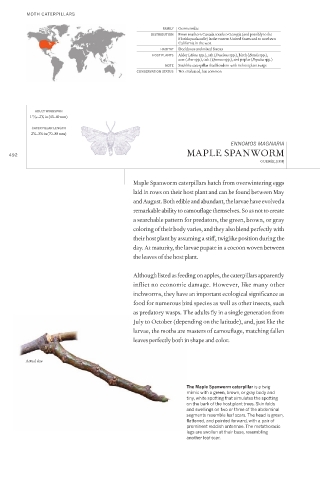
         Actual size


                                                             The Maple Spanworm caterpillar is a twig
                                                             mimic with a green, brown, or gray body and
                                                             tiny, white spotting that simulates the spotting
                                                             on the bark of the host plant trees. Skin folds
                                                             and swellings on two or three of the abdominal
                                                             segments resemble leaf scars. The head is green,
                                                               attened, and pointed forward, with a pair of
                                                             prominent reddish antennae. The metathoracic
                                                             legs are swollen at their base, resembling
                                                             another leaf scar.

