


Page 633 - The Book of Caterpillars: A Life-Size Guide to Six Hundred Species From Around the World
P. 633
MOTH CATERPILLARS

                      FAMILY  Noctuidae
                  DISTRIBUTION  United States, from southern Maine, south to Florida,
                           and west to Texas and Illinois
                     HABITAT  Woodlands and forest edges
                  HOST PLANTS  Greenbrier (Smilax spp.)
                      NOTE  Caterpillar that is a group-feeding leaf defoliator
             CONSERVATION STATUS  Not evaluated, but secure and regularly occurring


                                                                                   ADULT WINGSPAN
                                                                                    1 ⁄   in (30 mm)
                                                                                  CATERPILLAR LENGTH
                                                                                  Up to 1⅜ in (35 mm)


            PHOSPHILA TURBULENTA
            TURBULENT PHOSPHILA                                                                  631
            HÜBNER, 1818


            The Turbulent Phosphila caterpillar is a common species,
            typically encountered at early instars in tight clusters feeding
            gregariously on the underside of greenbrier leaves. Young
            larvae are pale green or tan in color, with a shiny black head
            and thoracic shield and indistinct lines traversing the length of
            their bodies. The more recognizable black-and-white, pinstriped
            “referee shirt” appearance manifests itself as the caterpillar
            matures. Later instar larvae may wander o  to feed on their

            own but prefer to regroup into layered colonies, alternated back
            to front, when at rest.


            On the posterior of the Turbulent Phosphila, a swollen fake
            head and “face” are designed to thwart predation. When
            threatened, the caterpillar curls its true head into the body and
            displays the false one as an alternative. It may also release its
            grip on the vine and drop to the ground to hide in leaf litter
            below. Two generations are typical throughout most of its
            range, with larvae present from May to November. The pupa
            overwinters, wrapped in silk within an enclosed leaf.


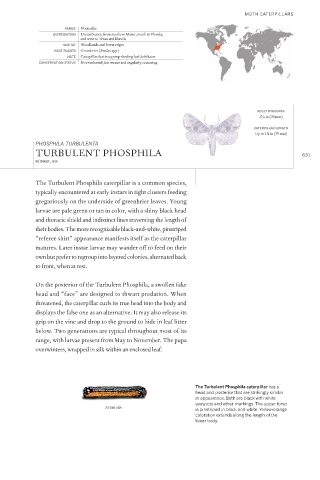
                                                               The Turbulent Phosphila caterpillar has a
                                                               head and posterior that are strikingly similar
                                                               in appearance. Both are black with white
                                                               eyespots and other markings. The upper torso
                                   Actual size
                                                               is pinstriped in black and white. Yellow-orange
                                                               coloration extends along the length of the
                                                               lower body.

