


Page 65 - The Book of Caterpillars: A Life-Size Guide to Six Hundred Species From Around the World
P. 65
BUTTERFLY CATERPILLARS

                      FAMILY  Papilionidae
                  DISTRIBUTION  Europe, across Asia Minor east to Mongolia, Russian Far East,
                           and northwest China
                     HABITAT  Subalpine meadows and dry scrubby hillsides, mostly at
                           2,460–6,600 ft (750–2,000 m) elevation
                  HOST PLANTS  Stonecrop (Sedum spp.)
                      NOTE  Black-and-orange caterpillar that mimics a large millipede
             CONSERVATION STATUS  Vulnerable


                                                                                   ADULT WINGSPAN
                                                                                  2¾–3⅜ in (70–85 mm)
                                                                                  CATERPILLAR LENGTH
                                                                                   Up to 2 in (50 mm)
            PARNASSIUS APOLLO
            APOLLO                                                                                63

            (LINNAEUS, 1758)


            The female Apollo lays up to 150 eggs on the host plant, either
            singly or in small groups, which then overwinter. When hatched
            the following spring, the young caterpillars are entirely black,

            making them difficult to spot. As they develop, they gain orange

            spots and become similar in appearance to a millipede found
            in the same habitat. Both the millipede and the caterpillars
            produce a foul-smelling liquid to deter predators—an example
            of Müllerian mimicry, a phenomenon first described in the
            nineteenth century by German naturalist Fritz Müller (1821–97).


            The caterpillar pupates on the ground in a loose cocoon. There
            is one generation annually and the adults are on the wing from
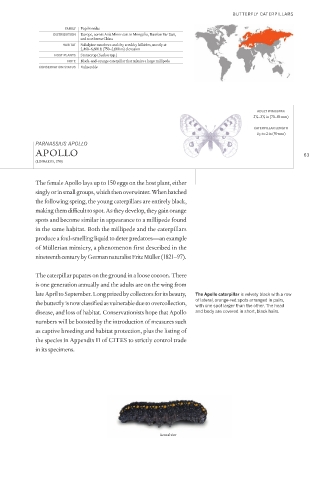
            late April to September. Long prized by collectors for its beauty,   The Apollo caterpillar is velvety black with a row

            the butterfly is now classified as vulnerable due to overcollection,   of lateral, orange-red spots arranged in pairs,

                                                               with one spot larger than the other. The head
            disease, and loss of habitat. Conservationists hope that Apollo   and body are covered in short, black hairs.
            numbers will be boosted by the introduction of measures such
            as captive breeding and habitat protection, plus the listing of
            the species in Appendix II of CITES to strictly control trade
            in its specimens.


                                                    Actual size

