


Page 64 - The Book of Caterpillars: A Life-Size Guide to Six Hundred Species From Around the World
P. 64
BUTTERFLY CATERPILLARS

                                                     FAMILY  Papilionidae
                                                 DISTRIBUTION  Northern Myanmar, northern Mongolia, Russian Far East,
                                                          China, Chinese Taipei, Korea, Japan, Ogasawara Islands,
                                                          Guam, and Hawaii
                                                    HABITAT  Woods, urban and suburban areas, and orange orchards
                                                  HOST PLANTS  Rutaceae, such as Phellodendron amurense, Poncirus trifoliata,
                                                          Zanthoxylum spp., and cultivated Citrus spp.
                                                      NOTE  Caterpillar that was once worshipped as a god in Japan
                                             CONSERVATION STATUS  Not evaluated, but common


            ADULT WINGSPAN
           1¾–4 in (45–100 mm)
           CATERPILLAR LENGTH
           2–2⅜ in (50–60 mm)
                                                                               PAPILIO XUTHUS
                                                        ASIAN SWALLOWTAIL
    62
                                                                                    LINNAEUS, 1767


                                            Like many Papilio species, the Asian Swallowtail caterpillar
                                            starts out looking like a bird dropping and ends up resembling
                                            a snake. The larvae feed initially on the upper surface of the
                                            leaf (where bird droppings land), but in a change regulated by
                                            juvenile hormones (JHs) they become green and snakelike,
                                            sometimes rearing up with a swelling thorax. The larvae can
                                            defoliate Citrus trees. Those developing later in the year may
                                            overwinter as pupae, but consequent adults eclosing in the spring
                                            tend to be much smaller than the summer generations.


                                            The Asian Swallowtail is among the best-studied butterfl ies,
                                            especially in Japan, where researchers have conducted many
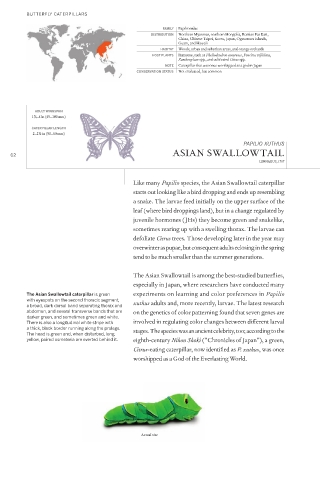
          The Asian Swallowtail caterpillar is green   experiments on learning and color preferences in Papilio
          with eyespots on the second thoracic segment,   xuthus adults and, more recently, larvae. The latest research
          a broad, dark dorsal band separating thorax and
          abdomen, and several transverse bands that are   on the genetics of color patterning found that seven genes are
          darker green, and sometimes green and white.

          There is also a longitudinal white stripe with   involved in regulating color changes between different larval
          a thick, black border running along the prolegs.   stages. The species was an ancient celebrity, too; according to the
          The head is green and, when disturbed, long,
          yellow, paired osmeteria are everted behind it.   eighth-century Nihon Shoki (“Chronicles of Japan”), a green,
                                            Citrus-eating caterpillar, now identified as P. xuthus, was once

                                            worshipped as a God of the Everlasting World.


                                              Actual size

