


Page 63 - The Book of Caterpillars: A Life-Size Guide to Six Hundred Species From Around the World
P. 63
BUTTERFLY CATERPILLARS

                      FAMILY  Papilionidae
                  DISTRIBUTION  Northeastern Australia (Queensland and Northern Territory),
                           New Guinea, and Solomon Islands
                     HABITAT  Rain forests and wet upland areas
                  HOST PLANTS  Doughwood (Melicope spp.) and Citrus spp.

                      NOTE  Well-camouflaged caterpillar that becomes a spectacular
                           blue adult
             CONSERVATION STATUS  Not evaluated, but quite common in its range


                                                                                   ADULT WINGSPAN
                                                                                  4–4¼ in (100–110 mm)
                                                                                  CATERPILLAR LENGTH
                                                                                  2⅜–2⁹∕₁₆ in (60–65 mm)
            PAPILIO ULYSSES
            ULYSSES SWALLOWTAIL                                                                   61

            LINNAEUS, 1758


            Ulysses Swallowtail caterpillars hatch from eggs laid singly,
            or occasionally in groups of two or three, on the young growth
            of host plants or on the underside of mature leaves. The larvae
            prefer to feed on young foliage and are often found on the
            regrowth produced after a tree has been felled or the branches
            cut. They feed singly, and there is usually only one per plant.
            When not feeding, the caterpillar rests on a silk pad attached to
            the upper side of a leaf. It feeds only on adjacent foliage.


            Natural enemies, including predators, parasitoids, and diseases,
            strongly regulate this species. Just prior to pupation, the
            caterpillars are particularly vulnerable to parasitic wasps. Adults
            in fl ight are an impressive sight, the brilliant blue upper side
            visible as a series of bright blue flashes in sunlight. Breeding

            continues throughout the year but is most abundant during
            the wet season.


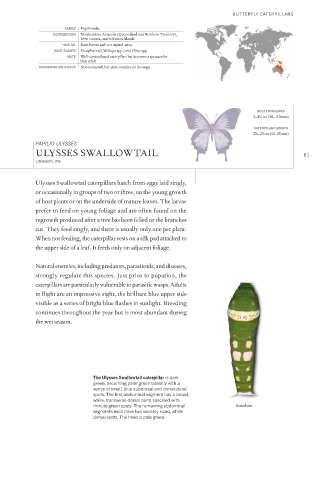
                               The Ulysses Swallowtail caterpillar is dark
                               green, becoming paler green laterally with a
                               series of small, blue subdorsal and dorsolateral
                               spots. The   rst abdominal segment has a broad,
                               white, transverse dorsal band speckled with
                               minute green spots. The remaining abdominal   Actual size
                               segments each have two variably sized, white
                               dorsal spots. The head is pale green.

