


Page 62 - The Book of Caterpillars: A Life-Size Guide to Six Hundred Species From Around the World
P. 62
BUTTERFLY CATERPILLARS

                                                     FAMILY  Papilionidae
                                                 DISTRIBUTION  United States, from New England to Florida, west to Texas
                                                          and Colorado
                                                    HABITAT  Marshlands, parks, gardens, meadows, and woodland edges
                                                  HOST PLANTS  Spicebush (Lindera benzoin) and Sassafras (Sassafras albidum)
                                                      NOTE  Caterpillar that is a structure-building master of mimicry
                                             CONSERVATION STATUS  Not evaluated, but may be rare in periphery of its range


            ADULT WINGSPAN
            3–4 in (76–100 mm)
           CATERPILLAR LENGTH
             2⅛ in (55 mm)
                                                                               PAPILIO TROILUS
                                                SPICEBUSH SWALLOWTAIL
    60
                                                                                    LINNAEUS, 1758


                                            Spicebush Swallowtail caterpillars spend their complete larval
                                            cycle within the leaves of the tree upon which the eggs were
                                            originally deposited. Young larvae are bird-dropping mimics
                                            that vary in coloration from green to brown, occasionally
                                            with white saddles across abdominal segments three and eight.
                                            When the caterpillar is inactive, a leaf enclosure protects it
                                            from predation. By the fourth instar, the body color changes
                                            to lime green, transforming the caterpillar into nature’s most
                                            convincing snake look-alike. Large eyespots and a retractable
                                            “forked tongue” (osmeterium) complete the illusion.


                                            The larva pupates within a silken harness, which hangs from
                                            the underside of a low-lying leaf of the host tree. The pupa can
                                            be green or brown, depending on the seasonal coloration of the

                                            surrounding foliage. The adult Spicebush Swallowtail butterfly
                                            also employs mimicry to avoid predation by closely imitating
                                            the Pipevine Swallowtail (Battus philenor), a similarly patterned

                                            but foul-tasting butterfly, which shares its range.


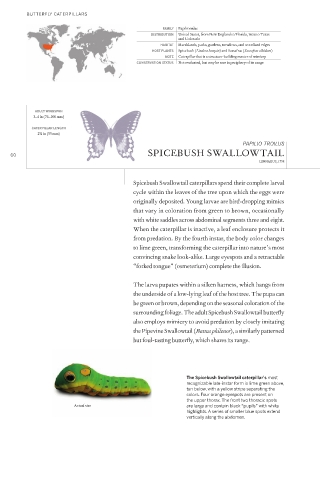
                                                             The Spicebush Swallowtail caterpillar’s most
                                                             recognizable late-instar form is lime green above,
                                                             tan below, with a yellow stripe separating the
                                                             colors. Four orange eyespots are present on
                                                             the upper thorax. The front two thoracic spots
                         Actual size                         are large and contain black “pupils” with white
                                                             highlights. A series of smaller blue spots extend
                                                             vertically along the abdomen.

