


Page 80 - The Book of Caterpillars: A Life-Size Guide to Six Hundred Species From Around the World
P. 80
BUTTERFLY CATERPILLARS

                                                     FAMILY  Hesperiidae
                                                 DISTRIBUTION  Across much of northern North America and northern
                                                          Eurasia, including Japan
                                                    HABITAT  Forest openings, mountain meadows, stream banks, and
                                                          moist lowlands
                                                  HOST PLANTS  Grasses, including Purple Reedgrass (Calamagrostis
                                                          purpurascens), Brome (Bromus spp.), and Reed Canary
                                                          Grass (Phalaris arundinaceae)
                                                      NOTE  Night-feeding grass caterpillar that builds a tubular nest
                                             CONSERVATION STATUS  Not evaluated, but vulnerable in parts of its range


            ADULT WINGSPAN
            ¾–1 in (20–25 mm)
           CATERPILLAR LENGTH
           1–1⅛ in (25–28 mm)
                                                                   CARTEROCEPHALUS PALAEMON
                                                                 ARCTIC SKIPPER
    78
                                                                                    (PALLAS, 1771)


                                            In North America, the eggs of the Arctic Skipper are laid
                                            singly on grasses in early summer and hatch within seven days.
                                            Development from first to fifth instar takes about six weeks, with


                                            fifth instars feeding slowly and entering dormancy after three

                                            weeks within a rolled grass-blade nest. After overwintering, the
                                            caterpillars leave the nest and pupate on a nearby grass blade.
                                            Protection is based on concealment, nocturnal feeding, and


                                            flinging frass to deter predators. Adults readily nectar on flowers
                                            and live for up to three weeks.

                                            Early caterpillar instars pull together the edges of grass blades,
                                            forming hollow, open-ended, tubular nests and tying them
                                            together with silk crossties. Feeding caterpillars often clip
                                            grass blades, leaving the outer 2–3 in (51–76 mm) tips to fall.
                                            The life history of Carterocephalus palaemon varies in Europe
                                            and Asia. Populations have declined in recent decades, and the
                                            species appears vulnerable to habitat disturbance and climate
                                            change. It disappeared from England—where it was known as
                                            the Chequered Skipper—in 1976.


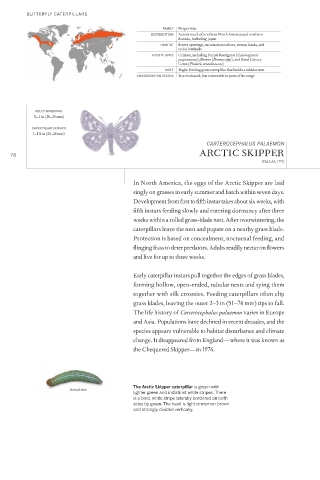
                                            The Arctic Skipper caterpillar is green with
                       Actual size
                                            lighter green and indistinct white stripes. There
                                            is a bold, white stripe laterally bordered on both
                                            sides by green. The head is light cinnamon brown
                                            and strongly divided vertically.

