


Page 19 - (DK) Eyewitness - Mars
P. 19
Average orbital speed of Venus:   Perihelion of Mercury:   Perihelion of Venus: 66.8 million
                    21.8 miles/sec (35 km/sec)  Mercury  28.6 million miles     miles (107.5 million km)
            Average orbital speed of Mercury:       (46 million km)                Perihelion of Earth:
            29.7 miles/sec (47.9 km/sec)
                                                                                    91.4 million miles
      Average orbital speed of Earth:                                              (147.1 million km)   Perihelion of Pluto:
      18.5 miles/sec (29.8 km/sec)                                             Perihelion              2,755.8 million miles
                                                                               of Mars:                 (4,435 million km)
      Average orbital speed                                                 128.4 0million
      of Mars: 15 miles/sec                                              miles (206.6
      (24.1 km/sec)                                                     million km)
                                                                   Earth
                                                               Venus
      Mars                                                  Sun
                                                 Aphelion of Mercury:
      Asteroid belt                                43.4 million miles              Perihelion of Uranus:   Perihelion of Neptune:
                                                    (69.8 million km)              1,703.4 million miles   2,761.6 million miles
      Aphelion of Mars:   Aphelion of Earth:                                       (2,741.3 million km)  (4,444.5 million km)
      154.9 million miles   94.5 million miles   Aphelion of Venus:
      (249.2 million km)  (152.1 million km)  67.7 million miles
                                          (108.9 million km)           Inner
                                                                       planetary orbits
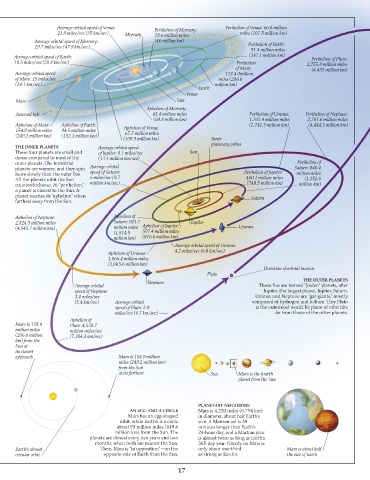
      THE INNER PLANETS           Average orbital speed
      These four planets are small and   of Jupiter: 8.1 miles/sec   Sun
      dense compared to most of the   (13.1 million km/sec)
      outer planets. The terrestrial                                                               Perihelion of
      planets are warmer, and they spin   Average orbital                                         Saturn: 840.4
      more slowly than the outer five.   speed of Saturn:                         Perihelion of Jupiter:   million miles
      All the planets orbit the Sun   6 miles/sec (9.7                            460.1 million miles   (1,352.6
      counterclockwise. At “perihelion,”   million km/sec)                         (740.5 million km)  million km)
      a planet is closest to the Sun. A
      planet reaches its “aphelion” when                                            Saturn
      farthest away from the Sun.

      Aphelion of Neptune:             Aphelion of
      2,824.5 million miles            Saturn: 941.1   Aphelion of Jupiter:   Jupiter
      (4,545.7 million km)             million miles                            Uranus
                                       (1,514.5   507.4 million miles
                                       million km)  (816.6 million km)
                                                           Average orbital speed of Uranus:
                                                           4.2 miles/sec (6.8 km/sec)
                                     Aphelion of Uranus:
                                     1,866.4 million miles
                                     (3,003.6 million km)
                                                                                        Direction of orbital motion
                                                                      Pluto
                                                  Neptune                                            THE OUTER PLANETS
                          Average orbital                                              These five are termed “Jovian” planets, after
                          speed of Neptune:                                             Jupiter, the largest planet. Jupiter, Saturn,
                          3.4 miles/sec                                              Uranus, and Neptune are “gas giants,” mostly
                          (5.4 km/sec)  Average orbital                             composed of hydrogen and helium. Tiny Pluto
                                       speed of Pluto: 2.9                            is the outermost world. Its plane of orbit tilts
                                       miles/sec (4.7 km/sec)                               far from those of the other planets.
                        Aphelion of
      Mars is 128.4     Pluto: 4,538.7
      million miles     million miles/sec
      (206.6 million    (7,304.3 km/sec)
      km) from the
      Sun at
      its closest
      approach                          Mars is 154.9 million
                                        miles (249.2 million km)
                                        from the Sun
                                        at its farthest                Sun      Mars is the fourth
                                                                                planet from the Sun


                                                                   PLANETARY NEIGHBORS
                                            AN EGG AND A CIRCLE    Mars is 4,220 miles (6,794 km)
                                           Mars has an egg-shaped   in diameter, about half Earth’s
                                         orbit, while Earth’s is a circle   size. A Martian sol is 39
                                        about 93 million miles (149.6   minutes longer than Earth’s
                                       million km) from the Sun. The   24-hour day, and a Martian year
                               planets are closest every two years and two   is almost twice as long as Earth’s
                                months, when both are nearest the Sun.   365-day year. Gravity on Mars is
      Earth’s almost              Then, Mars is “in opposition”—on the   only about one-third   Mars is about half
      circular orbit               opposite side of Earth from the Sun.  as strong as Earth’s.  the size of Earth

                                                            1

